




As the midterm elections approach, a lot of what appears in the press is best interpreted through a partisan lens. There’s already a baseline level of negativity bias as editors and algorithms have optimized toward the tendency of humans to click on bad news. Between now and Election Day, the economic, technology, and geopolitical news will have a particularly grim cast as reporters race to try to convince readers that an economy with 4.1 percent unemployment, consumer spending up 4.5 percent year over year, and robust stock market gains is the second coming of a Great Depression, or at least 1970s stagflation.
Yet even by the standard of partisan cheerleading, every once in a while—okay, almost every day—an article comes along that is so shameless in its Democratic Party advocacy that it’s enough to make a reader laugh out loud, or at least engage in a visible eye-roll.
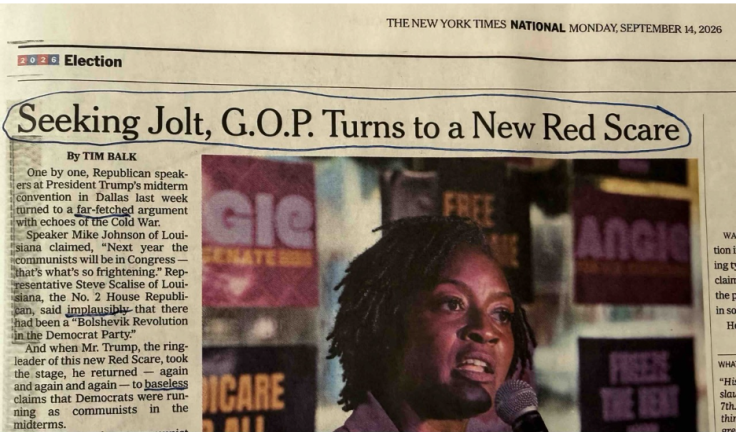
In that category can be placed an article that appeared in the print New York Times under the headline "Seeking Jolt, G.O.P. Turns to a New Red Scare." It solemnly assures New York Times readers that Republican accusations that the Democrats are communists are "far-fetched" and "baseless" because, after all, "no credible midterm candidate identifies as a communist." Also, the charge "has little overlap with Democrats’ actual platforms."
After all the dismissiveness, in the 14th paragraph the Times allows that "In some ways, far-left leaders have fed the argument. In 2020, Senator Bernie Sanders of Vermont, a leader of the progressive movement and a self-described democratic socialist, praised elements of the Communist Cuban revolution. And Darializa Avila Chevalier, a democratic socialist who unseated a Democratic congressman in a New York primary in June, once maintained a social-media account that circulated a post suggesting that public libraries should carry more Marxist literature."
Communists in the U.S. and elsewhere in the West have frequently been covert about it. And just because someone calls themselves a socialist doesn’t mean that their program isn’t essentially communist; the Soviet Union, after all, was the Union of Soviet Socialist Republics, or USSR.
The Democratic Socialists of America program calls for seizing property: "Establish public ownership of the largest corporations and essential industries to ensure democratic control and accountability to the people." It also calls for abolishing the U.S. Senate. The DSA issued a statement last month on the 100th birthday of Fidel Castro, the Communist dictator, expressing "solidarity" with the Cuban revolution and praising Castro as "a stalwart symbol of anti-imperialist struggle and self-determination for the Global South." There were fiercely anticommunist socialists in the U.S. at various points in 20th century history, but nowadays those battle lines are more blurred and less crisp.
A Quinnipiac Poll conducted earlier this month found 59 percent of Democrats consider themselves supporters of the Democratic Socialists of America. It was a small sample—970 self-identified registered voters in the entire poll—but it suggests that the effort to tar the Democrats with the DSA program may not be quite as "baseless" as the Times insists.
The Times article carries the byline of Tim Balk, who in 2015, as the assistant opinion editor of the Daily Northwestern, called Trump a "clown" and declared, "In a Republican primary field littered with climate-change deniers, xenophobes and out-of-touch political dinosaurs, Trump might be the worst."
The Times article also says Taylor Robinson "contributed reporting." Robinson declared in 2018, "I care a lot about immigrant rights and basically the rights of any marginalized group, so I’d love to make a career advocating for those who are underrepresented, especially in the current political climate."
No one begrudges young people's immature political views—the word "sophomoric" exists for a reason—but the Times news article offers no indication that Balk has outgrown his view of Trump as a clown or that Robinson has outgrown her ambitions for "a career advocating." And what a coincidence that the immature political views expressed by the Times political reporters lean predominantly leftward rather than in the other direction.
A few pages deeper into the print Times comes a Michelle Goldberg opinion column with an enthusiastic plug for Naomi Klein and Astra Taylor’s "trenchant new book, ‘End Times Fascism.’" Klein and Taylor also get an interview in the Times magazine and a Times podcast. A January Goldberg column declared, "From the moment he descended his golden escalator, Trump’s message, the emotional core of his movement, has been textbook fascism."
In the waning days of the 2024 presidential campaign, when Kamala Harris accused Trump of fascism, the Times trotted out Jonathan Weisman to declare that "The definitions of fascism, however, have never been completely fixed as each new generation’s authoritarians vary their forms and methods of control." When it comes to Trump’s accusations of communism, however, there is no such flexibility, just the Times getting on its high horse about how "baseless" the accusation is. It’s a classic Times double standard.
The Times has been an unreliable source on communism for nearly a century now, dating back to Walter Duranty’s whitewashing of Stalin’s crimes in the 1930s and continuing through Herbert Matthews’ boosterish coverage of Castro in the 1950s. Let them keep dismissing the threat as a "Red Scare" until President Ocasio-Cortez, Senator Sanders, and other leftists decide that "establish public ownership of the largest corporations and essential industries" applies to the New York Times Company. The sanguinity might suddenly subside once the "socialism" comes for the Sulzbergers.