

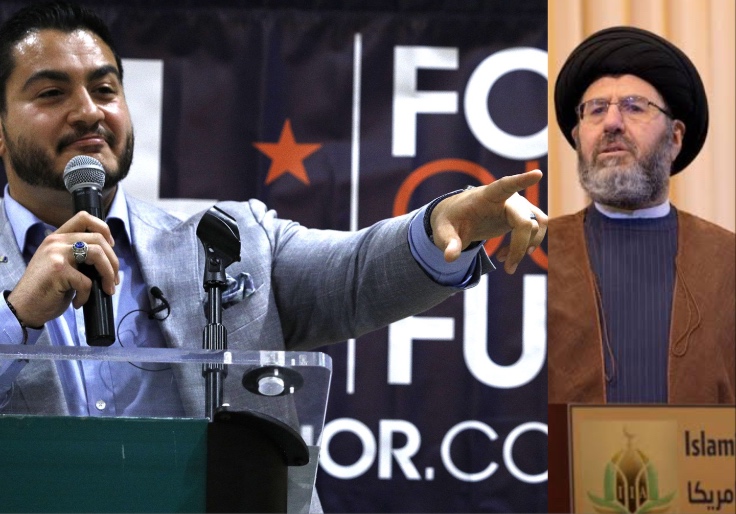
Michigan imam Hassan Qazwini forcefully urged his congregants to turn out in force for Abdul El-Sayed on Tuesday, casting the Democratic Senate primary as an epic battle between a "clean" candidate and a "Zionist candidate" involved in a "plot being schemed by the pro-Israeli lobby."
Qazwini—the head of the Islamic Institute of America who has been accused by socialist Sen. Bernie Sanders (I., Vt.) of "spreading antisemitic conspiracy theories"—encouraged congregants in sermons on July 24 and July 31 to support El-Sayed over primary opponent Haley Stevens. His sermons are part of an 11th-hour push on behalf of El-Sayed that makes clear the imam views Israel as the central issue in the Senate race.
The support is mutual. El-Sayed headlined the grand opening of the Islamic Institute of America on June 6, offering "hearty congratulations" to Qazwini and praising his "incredible masjid," a 67,000-square-foot facility that features five golden domes.
In a July 24 sermon, Qazwini called Stevens, a pro-Israel moderate, a "puppet" of Israel and invoked tropes about Jewish influence and money, while framing a vote for El-Sayed as both a "moral responsibility" and a "religious duty."
"Israel cares about its own interest and the money, the cash the U.S. pays it, because Israel and the pro-Israeli lobby, all they see in America … is a cash cow," said Qazwini, whose father was appointed to Iran's judiciary by Iran's first supreme leader, Ayatollah Khomeini.
"Beware of the plot being schemed by the pro-Israeli lobby for you. They don't care about you, Michiganders. All they care about [is] their own interest," Qazwini went on. Qazwini, who formally endorsed El-Sayed last week, also urged worshippers to view their votes as a "huge and powerful weapon" to strike back at "Zionists."
"The way to deal the Zionist a bigger blow is to go and cast your vote on Tuesday, and don't allow the Zionist candidate to win," Qazwini said in the July 31 sermon. "You have to choose between people, clean people, who are running to serve your community, your state, and people who are there to serve the interest of Israel."
While Qazwini's support could help El-Sayed in Tuesday's Democratic primary, the backing from an extremist cleric could prove a liability for El-Sayed in the general election. Republicans have cast El-Sayed as "radical" and are certain to highlight his connections to anti-Israel clerics and activists. El-Sayed has campaigned with the far left-influencer Hasan Piker, who said that "America deserved 9/11," and with New Jersey House candidate Adam Hamawy, who testified on behalf of the "Blind Sheikh," the mastermind of the 1993 World Trade Center bombing.
Qazwini has a long history of inflammatory and antisemitic rhetoric. In 2020, Sanders's presidential campaign denounced what it called Qazwini's "antisemitic conspiracy theories" and "toxic" comments after Qazwini claimed that Israel funds ISIS and that the terrorist group was "playing the role of the arm of the Zionist in the Muslim world." And Qazwini has described Sanders as an honorable man, "even though he is a Jew."
In 2024, Qazwini labeled lawmakers who supported the Antisemitism Awareness Act "stooges of Israel" and said they should be "indicted and convicted of treason."
And Qazwini has publicly praised Iran and Hezbollah, the Iran-backed terrorist group in Lebanon. In a June 26 sermon, he said Iran had "stood firm" and "humiliated the most powerful man on earth." During a March 24 sermon, he prayed for Allah to "grant victory to our brothers in Iran" and "inflict defeat upon Your Zionist enemies," according to an English translation.
He likewise praised slain Hezbollah leader Hassan Nasrallah as a hero of the "resistance," saying Nasrallah's death at the hands of Israel's military would become "fuel to sustain the resistance against Israel."
Unlike Sanders, El-Sayed has never publicly criticized the antisemitic-trope-slinging imam.
While El-Sayed is an outspoken critic of Israel, accusing the Jewish state of "genocide," he has stopped short of criticizing enemies of Israel and the United States out of fear of upsetting voters in Dearborn, a heavily Muslim and Arab enclave that makes up El-Sayed's strongest base of political support.
During a campaign strategy call in March, El-Sayed said he wanted to avoid answering questions about the death of Ayatollah Ali Khamenei out of concern that it would upset Dearborn residents.
"I also want to remind you guys that there are a lot of people in Dearborn who are sad today. So, like, I just don't want to comment on Khamenei at all," said El-Sayed, according to a recording obtained by the Washington Free Beacon.
El-Sayed's campaign and the Islamic Institute of America did not respond to requests for comment.