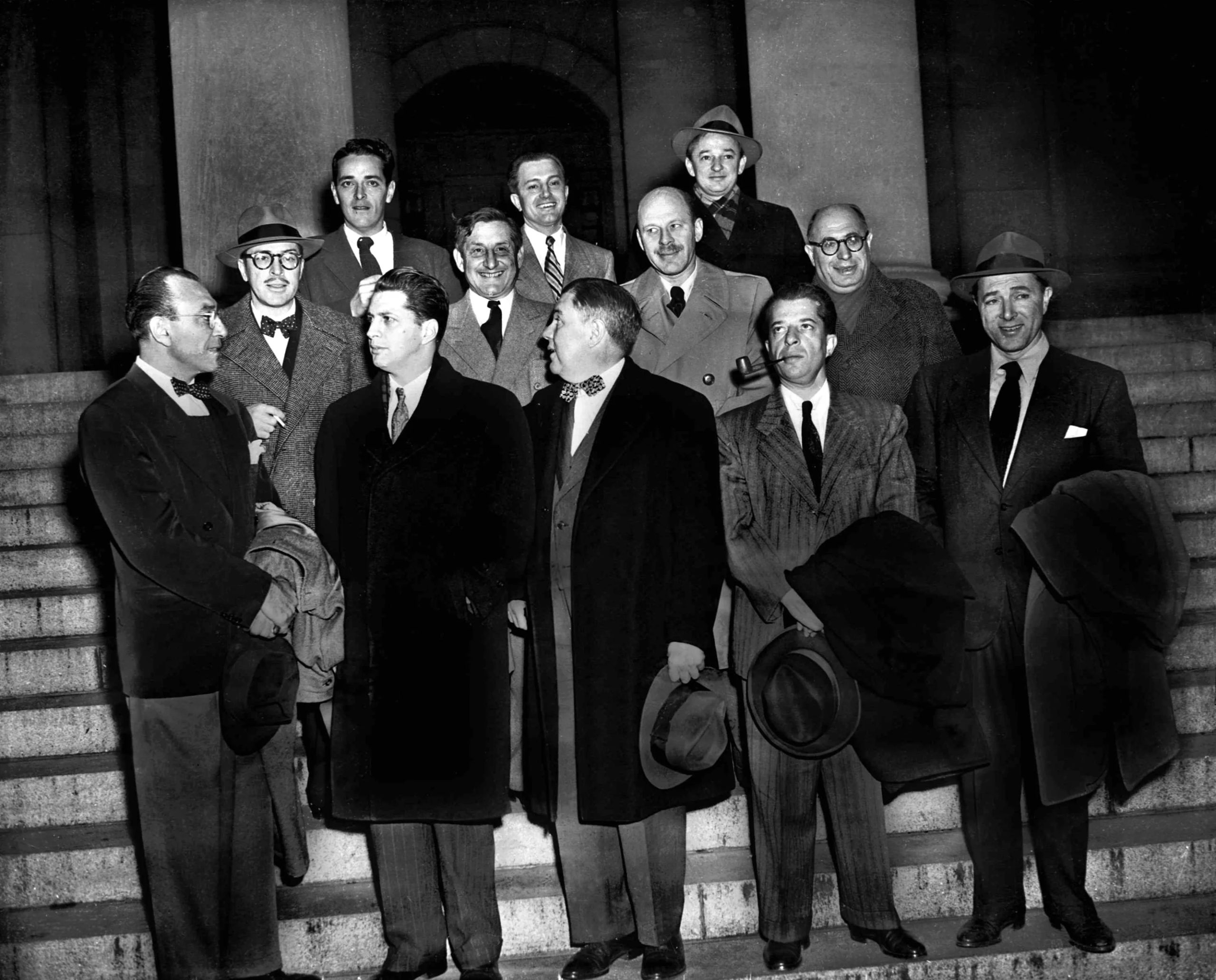


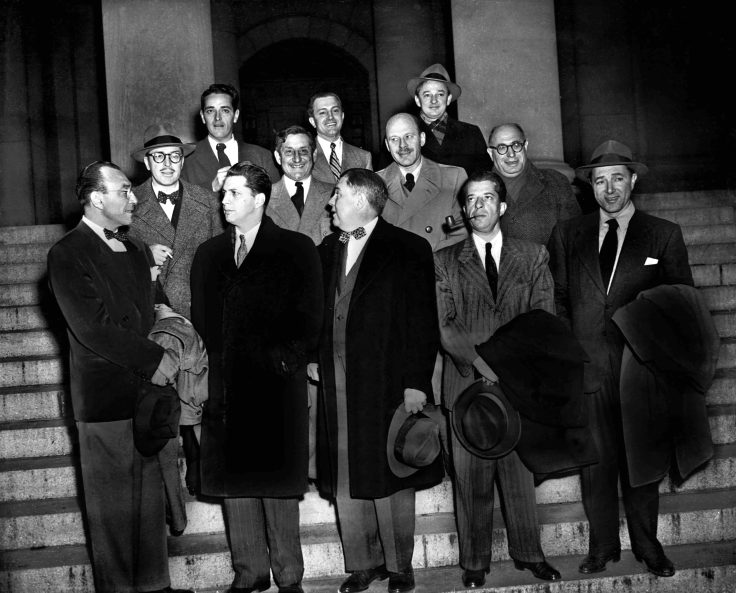
An exhibit on loan from the Jewish Museum in Milwaukee is now at the Capital Jewish Museum in Washington, D.C., where it is getting new and important attention. "Blacklisted: An American Story" tells viewers it "explores the Hollywood blacklist and the federal government’s loyalty investigations. … Through powerful personal stories, rare artifacts, and film clips, the exhibition reveals how fear, politics, and identity collided—and what was lost when dissent was silenced." As the Guardian (U.K.) put the exhibit’s purpose: "There’s no shortage of comparisons with the second Trump administration to the rise of Nazism in 1930s Germany, but perhaps the more apt comparison is to the Red Scare in postwar America."
There are already about nine Hollywood movies and a few television dramas that depict the Hollywood Communists as well-meaning idealists who favored an end to racism and Jim Crow, world peace, and a decent America in which freedom of speech is treasured. This new exhibit follows along the same lines. It argues that those who sought "gender equality, civil rights, peace organizing and other ‘left-wing’ ideologies were interpreted as a sign of adherence to Communist ideology." This simplistic and false narrative makes it appear that blacklisting Hollywood Communists, who in fact put their allegiance to Stalin’s Soviet Union above anything else, was just an excuse to repress well-meaning advocates of peace and justice.
The narrative then turns to a section seeking to explain that the Communist Party of the United States "was the only interracial political party, and the only party with a platform supporting racial equality and self-determination for Black communities." Of course, students of American communism know well that the heart of the party was to work on behalf of whatever goals the Soviet Union favored at the moment. The CPUSA did fight against injustices toward black citizens by racists; the most famous effort was the campaign to free the framed-up "Scottsboro Boys."
The party, however, did not advocate for civil rights. For decades, until the 1960s Civil Rights movement, the CPUSA followed the advice of one of its major black leaders, Harry Haywood, who in 1948 wrote a book titled Negro Liberation. His argument was that the "Black Belt" in the South (referring to many black majorities in contiguous Southern states) was a separate and distinct nation of its own, and in effect was a colony of American imperialism. Haywood developed this idea by saying it met Stalin’s requirements for establishing a nation.
The CPUSA, in other words, did not support "racial equality" and an end to segregation in the South and equal rights of black Americans throughout the entire United States. True civil rights advocates in the CP kept their mouths shut until after the Civil Rights movement of the ’60s began. Then, the Soviet Union’s leadership took notice of this new development and ordered the American Communists to give up the effort to attain "Negro liberation" and fight instead for ending segregation by joining and trying to gain influence in the new black freedom movement. Haywood himself was quickly expelled from the CP’s ranks for Maoism, "revisionism," and "left-wing sectarianism."
Next, the exhibit turns to the Communist Party as a separate entity, and its effect on different groups. We are told, correctly, that the effect of the revelations about Stalin’s actual horrors (the Khrushchev Report of February 1956) led to the disillusionment of many who then exited the ranks of the CP. It then turns to how their once being members (or fellow-travelers) caused problems for them in gaining jobs or remaining in a position they held, especially in the U.S. government.
The exhibit, however, simply explains it by stating: "These affiliations with anti-Fascist groups and [the] CPUSA would haunt and ruin many American careers during the Red Scare." The Communists and their allies are always seen as persecuted, and as having nothing to do with people and organizations breaking with them. The truth was stated by left-wing historians Larry Ceplair and Steven Englund, who write in Inquisition in Hollywood, all the Hollywood Communists "defended the Stalinist regime, accepted the Comintern’s policies and about-faces, and criticized enemies and allies alike with infuriating self-righteousness, superiority, and selective memory which eventually alienated all but the staunchest fellow travelers." Why is this understanding not revealed to visitors to this new exhibit?
As for Jewish Americans, it notes that many antifascists were Jews, which of course was for good reason given their early awareness of the Nazi agenda defined by Adolf Hitler. Yet, the exhibit only cites a memo from the American Jewish Council’s concern over "public disclosures of spy activities by Jews," that such disclosures led to fearing that non-Jews would generalize them "as a group [which had] treasonable motives and activities."
There is, of course, another reason: Most of the Hollywood Communists and Hollywood members of the party were Jewish! It was the same in New York City, where the two leading cultural apparatchiks, V.J. Jerome and screenwriter John Howard Lawson, flew to Los Angeles to take over the Hollywood CP in order to assure its members followed the party’s instructions.
A section called "Unfriendly Witness" then turns to the plight of the Communist screenwriter Albert Maltz, who, showing a streak of independence, wrote an article for the Communist cultural magazine, New Masses. Therein he posited in 1946 that the "accepted understanding of art as a weapon is not a useful guide, but a straightjacket." His viewpoint challenged the entire CP view of art. The immediate response from his comrades was to condemn him for abandoning Marxism, for holding "bourgeois concepts," for holding a "discredited humanist tradition," for ignoring the "class struggle." Finally, CP chairman Eugene Dennis said that what Maltz wrote was "a bourgeois-intellectual and semi-Trotskyite article."
Maltz is presented as a hero. The exhibit fails to tell viewers that he immediately capitulated to his comrade’s demands to repudiate what he had written and obviously believed. Apologizing that his article was nothing less than "a non-dialectical treatment of complex issues," Maltz agreed that, if listened to, "would lead to the dissolution of the left-wing cultural movement." Having refused to cooperate with HUAC and name names of those he knew in Hollywood to be fellow Communists, he revealed it was harder to stand against one’s own group and milieu than it was to tell HUAC to go to hell. To oppose HUAC was to gain the approval and support of his Communist movie community; to write something he believed and that was opposite to the tenants of Marxism-Leninism meant complete ostracization that only succumbing to the party’s demands made on him would restore him to good standing.
As for the CPUSA itself, one panel informs us that "Those identifying as anti-Fascists … would later find themselves in the crosshairs of the blacklist, labeled ‘premature anti-Fascists’ (i.e., those who were anti-Fascists in the 1930s, before the U.S. entered WWII)." That charge quickly expanded to many on the pro-Soviet left who used it to show how prescient they were before anyone was antifascist, and how during the Cold War, their early knowledge was now used against them by anticommunists in the armed services and by civilian witch-hunters.
That claim is completely false. Only one person—a veteran of the Abraham Lincoln "Brigade" (actually a small battalion) that fought for the Republic in Spain during that country’s civil war against Francisco Franco’s Falangist army—claimed that when he looked at his armed forces security file, it listed him as a premature antifascist. Historians John Haynes and Harvey Klehr showed conclusively that the claim was entirely false; no government or army files made that claim.
The charge was also made by veterans of the Brigades in the ’60s, who wanted to establish that they were antifascists before it was popular to be one. Historian David A. Walsh challenged Haynes and Klehr’s argument in 2012, yet he admits it was "probably apocryphal" but came to mean eventually "broader discrimination against liberals and leftists." Historians, however, cannot successfully explain this away, since nothing anyone says about the accuracy of past events can be changed from the truth. They should never cite "apocryphal" charges to prove a false claim.
That claim, moreover, ignores that when the Nazi-Soviet Pact was signed in Moscow, overnight the Brigade veterans became anti antifascist, arguing publicly that Hitler’s Germany was a benign power, and that the real threat to peace came from the United States and Britain, which wanted to drive the United States into war. The last commander of the Brigades, Milton Wolff, speaking to the veterans at their annual convention that took place in May 1941, denounced as equally evil "Roosevelt, Hitler, Churchill, and Mussolini." He attacked FDR for wanting America to participate in the "imperialist slaughter in which the youth of our country, will, if he has his way," seek U.S. "involvement … in an imperialist war from which the great majority of the American people can drive only misery, suffering and death." He stated that the Brigade veterans’ organization "opposes every move of Roosevelt and the warmongers in this direction."
Members who opposed the Nazi-Soviet Pact were immediately expelled from the organization by Wolff. So much for their prescient antifascism! Why is this not in the exhibition?
Then one must pay attention to the most famous of all the blacklisted Hollywood writers, the talented and brilliant screenwriter Dalton Trumbo. During the years of the Nazi-Soviet Pact, Trumbo had published his novel Johnny Got His Gun, a searing antiwar novel (made into a Hollywood film during the Vietnam war) about a World War I vet who lost his sight and all his limbs. It was meant to increase antiwar sentiment when the FDR administration was beginning to provide aid to Great Britain. It won the National Book Award for Best Original Novel in 1939.
When Nazi Germany invaded Russia in 1941, Trumbo and his publisher suspended printing of Johnny Got His Gun, and Trumbo appealed to readers who had bought it to return or destroy the book. He also did one other little-known action: In 1944, he asked the FBI to come to his house to look at letters he had received from people who wanted to know how they could get a copy of Johnny Got His Gun. Charging that the writers were clearly still antiwar, still isolationist, and some were as well pro-Hitler and opposed fiercely to the president, he gave their names to the bureau. His view, he wrote the FBI, was that his book "shouldn’t be reprinted until the war was at an end." He was afraid, however, that the letter-writers "could adversely affect the war effort" if the book was made available. In 1970, he acknowledged that "I foolishly reported their activities to the FBI." Yet he still thought he was right to oppose getting into the war in 1939 because it would be a "disastrous course" to move away from isolationism, which is also why he spoke up against Lend-Lease aid to Britain, arguing that would be like handing a gun to a "hot-headed man."
Years later, Trumbo bragged that due to his influence in the film colony, he was able to stop a Hollywood movie that was to be made about Leon Trotsky. Yet, Trumbo himself came to see the truth about the totalitarian Soviet Union. He had read, he admitted, all the major anticommunist books, and hence, "I was not surprised." As for the CP, he knew the blacklisted writers were used for the party’s own agenda. He was furious that they were "exploited for every left-wing cause that came down the pike."
As for the Soviet Union, Trumbo acknowledged it was "succumbing to dictatorship." If a Communist really was engaged in espionage for the USSR, he wrote, a man has "but no choice to report everything, including names, to the authorities." It was a "legal and moral duty." Such a man was "a good citizen and patriot." In response, a friend and Communist screenwriter, Guy Endore, wrote him that Julius and Ethel Rosenberg were made a cause by the party to deflect attention from the "horror of the Prague trials," in which scores of loyal party leaders were found guilty of ties to Zionist causes and American imperialists.
Why was there no indication of any of these facts about Trumbo made available to viewers of the exhibit?
As for the threat from right-wing anticommunists, it does not appear that the curators of the exhibit realized that by the Reds’ pro-Soviet views held during the early Cold War, they had broken apart the old wartime alliance between the pro-Communist left and the liberal community. Had the alliance with liberals continued, it might have served as a challenge to the extreme anticommunism of the McCarthyites. Instead, the broad left began to lose influence on the country, and the actions of the Reds gave ammunition and justification for the propaganda of the McCarthyite right.
The exhibit, I sadly conclude, is mostly a whitewash of the Hollywood Communists whose careers were put to a halt. The exhibitors present the injustices and mistakes of the right-wing anticommunists and McCarthyites. That does not mean those who were anticommunists took positions that were irrational.
Ronald Radosh is a historian and co-author with Allis Radosh of Red Star Over Hollywood, a book about the Communists and the blacklist.