



"Images are the literature of the layman," says the narrator of The Name of the Rose, the book by Umberto Eco. He's explaining the art of churches. The character would have had no idea about movies—his tale takes place in medieval times—but perhaps he'd appreciate the project of bringing a popular novel to the big screen, as director Jean-Jacques Annaud did with The Name of the Rose in 1986.
Yet adapting this book may be impossible. It's at least difficult. The film industry loves movies about movies, from Sunset Boulevard to Once Upon a Time in Hollywood. The Name of the Rose, however, is a book about books. It's a feast for readers. The printed page is its proper medium. This is apparent in its epigraph: "Naturally, a manuscript." The implication is that anything else would be unnatural.
Annaud attached his own epigraph to the movie, right after flashing the title card: "A palimpsest of Umberto Eco's novel." Had anyone before this called a movie a "palimpsest"? That's a big word. It's a word for readers, possibly with dictionaries handy. It's not a word for moviegoers in the dark of theaters. You can almost hear a producer, during a review of storyboards: "Get me a rewrite!"
As it happens, a palimpsest is a rewritten manuscript—or, more precisely, a manuscript that has been written upon more than once, involving partial erasures but with the original text still visible. (I know because I looked up "palimpsest" in a dictionary.) A lot of literature from the ancient world survives through palimpsests. The most notable example may be the Archimedes Palimpsest, a Byzantine prayer book that preserved the works of a Greek mathematician from the 3rd century B.C.
So this is an interesting metaphor for a movie whose source material is a book.
And what a book. After its first publication in Italy in 1980, The Name of the Rose sold millions of copies in dozens of languages. By the time the English translation by William Weaver came out in 1983, it was a literary sensation. It remains enduringly popular. Even Bishop Robert Barron has put it on a recommended reading list.
Its commercial and critical success was a surprise. Eco was an obscure professor at the University of Bologna. He had written only for academic audiences, mostly about semiotics—another word that cries out for a dictionary. (It means the study of signs and symbols.) His erudition fuels The Name of the Rose, in which he name-drops everyone from Adelard of Bath to William of Moerbeke. (They are, respectively, an English Benedictine who translated Arab works into Latin and a Belgian Dominican archbishop who worked with Greek texts. I know this because I looked them up, too, in The Key to The Name of the Rose, a helpful guide by Adele J. Haft, Jane G. White, and Robert J. White.) The only learned reference Eco doesn't make, it seems, is to Archimedes.
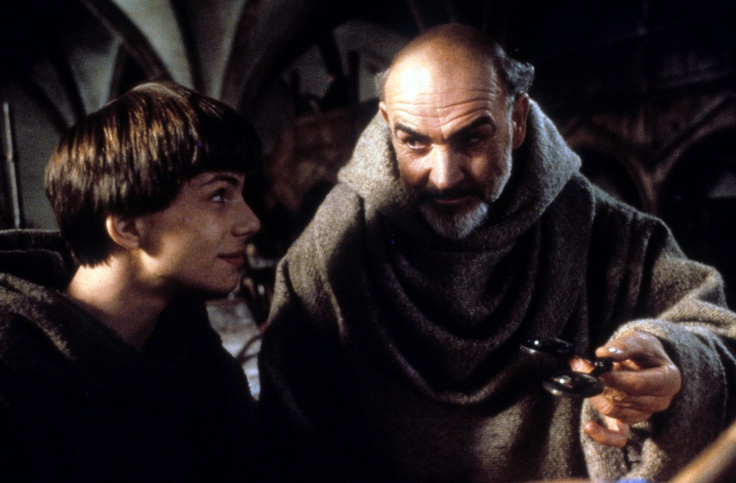
At the center of the book's story is a murder mystery—a great plot, ready for use by Annaud. The main character is Brother William of Baskerville, played by Sean Connery, then in his 50s and famous for his portrayal of James Bond. The actor's familiar Scottish accent might seem out of place in a 14th-century Italian abbey, except that William is in fact British. He's a Franciscan monk who is one part philosopher and one part criminal investigator.
"Baskerville" is another of Eco's allusions, pointing to The Hound of the Baskervilles, the novel of Sherlock Holmes by Arthur Conan Doyle. William's sidekick is his apprentice Adso, played by a tonsured Christian Slater, who was a teenager during the filming. "Adso" and "Watson," by the way, are paronyms, which are words that share similar sounds and often common roots. Connery even utters a Sherlockian line that isn't in the novel: "It's elementary."
As the movie begins, William and Adso enter the weird world of the unnamed abbey, where a game of suicide and murder is afoot. Arnaud populates the place with a cast of monks who look and act creepy, including the pale and fat Berengar (acted by Michael Habeck) and the beak-nosed Malachia (Volker Prechtel). The most striking figure is Salvatore, a hunchbacked idiot played brilliantly by Ron Perlman, who speaks in a gibberish of blended languages. He is at once revolting and pitiable.
Salvatore is unwittingly at the center of an intellectual dispute about poverty and property. Did Jesus own the clothes he wore? It sounds like a question that only a theologian would think to ask, but it may carry profound implications for those who seek to live like Christ—and for a church that possesses wealth. In the book, popes and princes clash over the matter, in a dispute that mixes power politics with a sincere desire to follow the faith. The movie tries to capture its general contours, but with a ham-handed anti-papal bias that is less obvious in the novel.
At least it's a failure in the right direction: Annaud faced the hard task of turning a 500-page book of encyclopedic learning and daunting ambition into a movie that clocks in at just more than two hours. He simply could not include everything. He arguably includes enough. Eco was judicious in his assessment, in an interview with the Guardian in 2011: "A book like this is a club sandwich, with turkey, salami, tomato, cheese, lettuce. And the movie is obliged to choose only the lettuce or the cheese, eliminating everything else—the theological side, the political side. It's a nice movie."
The conclusion is a case in point. In both the novel and the movie, the abbey's major feature is not a chapel but a library that doubles as a labyrinth. Eco lets it become an intellectual puzzle, complete with a diagram for readers to scrutinize and possibly inspired by a maze on the floor of the Reims Cathedral in France. He also uses it to introduce a series of thematic tensions: stability versus progress, orthodoxy versus dynamism, and ignorance versus knowledge. Eco invites readers to think big about how societies create order as well as how they evolve. This is much more than Annaud can tackle, and it spoils nothing to say that the director lets the library star in a pyrotechnic climax worthy of a summer blockbuster. But then so does the novel, which at its beating heart is a highfalutin potboiler.
"We live for books," says one of Eco's characters. If the movie succeeds, it's because this idea comes across, just barely discernible—like a remnant line on a palimpsest.
Editor’s note: This retrospective review is one in a series celebrating 1986, arguably the greatest year in movies—inarguably if you’re Gen X.
John J. Miller is director of the Dow Journalism Program at Hillsdale College and a Free Expression columnist for the Wall Street Journal.