





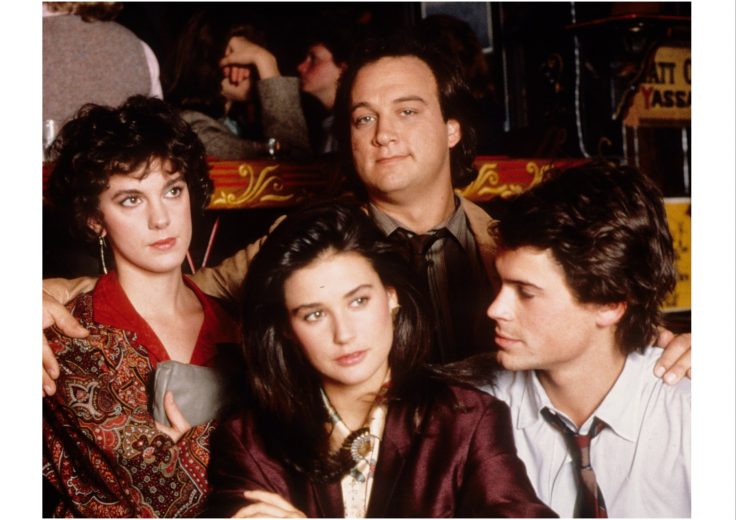
During the opening credits of About Last Night, we hear before we see two men having a conversation about a one-night stand. F-bombs proliferate, there is a crude, offhand discussion of female body parts, and a considerable amount of speculation about whether the female in question might, in fact, be a prostitute. "Was she a pro?" one man asks. "You think she hadn’t been around? Hadn’t done the route?" the other responds.
I still remember the shock my teenage self experienced hearing grown men talk so bluntly about something we had been raised to believe was very, very serious (sex) and how cavalier they were about the woman involved. And yet the scene was nearly impossible to forget, even before the two men talking, played by an almost-too-pretty Rob Lowe and a swaggering James Belushi, are shown on-screen.
It turns out this scene was my first exposure to something else as well: the compelling, profane, and pitch-perfect writing of playwright David Mamet. The movie was an adaptation of his 1974 play, Sexual Perversity in Chicago. Alas, that opening scene was the only bit of pure Mamet we get in the movie. Critic Roger Ebert gave About Last Night four stars in his review, but Mamet always disavowed it and publicly expressed his regret at selling the rights to the play so cheaply in his youth.
Set in the North Side of Chicago, About Last Night is a comedy-drama that tells the story of Danny (played by Lowe), an affable but callow ladies’ man who is unfulfilled in his work as a restaurant supply salesman, and Debbie (played by Demi Moore), who works as a creative director in an advertising agency where she is having an apathetic affair with her much-older boss.
In the pantheon of Gen X movies, About Last Night might be understood as a mea culpa for Lowe and Moore, who had starred together the previous year in the classic (and terrible) Brat Pack-defining ensemble movie, St. Elmo’s Fire. Among my Gen X friends, we have a standing joke: Whenever someone from a younger generation asks us what the best disaster film of the ’80s was, we tell them St. Elmo’s Fire.
In About Last Night, Lowe and Moore are given room to demonstrate greater range, aided and in many scenes outshined by their costars, Belushi, and an excellent Elizabeth Perkins. Belushi, who plays Lowe’s sidekick and best friend, Bernie, is a walking, talking 1980s stereotype of loudmouthed misogyny and unfiltered id. He is the movie’s comic relief, and his interactions with Perkins’s prickly character, Joan, a kindergarten teacher and Debbie’s best friend and roommate who has no tolerance for male shenanigans, are mordantly funny.
The movie circles around two themes—sex and love—and how to achieve a great deal of the former while strenuously avoiding the latter. The characters are only in their 20s, but both the men and the women are portrayed as sophisticated (or possibly already jaded) about sex, and largely clueless when it comes to love. We meet Debbie and Joan at a weekend softball game, where they are ogling the men on the field. Spotting Danny, Joan remarks, "I refuse to go out with a man whose ass is smaller than mine." Later, when discussing their various male conquests, Joan and Debbie laugh, "Aren’t we a couple of sluts!"
Debbie and Danny find each other that night at a local bar called Mother’s (filmed at the iconic Chicago bar on Division Street of the same name, which, in the 1970s, hosted shows by The Velvet Underground and the Mekons). They move quickly to Danny’s apartment, with Debbie gently mocking Danny’s well-rehearsed but ultimately successful seduction techniques. Debbie’s attempt to make a quiet post-coital exit is unsuccessful, but she makes it clear to Danny she viewed the night as a onetime thing.
Yet they both end up wanting to see each other again, despite their friends’ advice not to appear too eager. "Never call a broad more than twice a week!" Bernie warns Danny. When Danny tries to persuade Debbie that he has real feelings for her, she initially replies, "Danny, I may be easy but I’m not stupid." A few months later, Debbie is moving into Danny’s apartment, with her friend Joan disapprovingly predicting, "I give you two months."
Never underestimate the efficient allure (and epic cheesiness) of the ’80s film montage, particularly one with Sheena Easton’s "So Far So Good" as its background music. About Last Night abuses the privilege: We have the "falling in love" montage, the "moving in together" montage, the "intimacy" montage, replete with sex scenes in bathtubs and plenty of nudity by a pre-silicone (analog?) version of Demi Moore as well as lingering shots of the couple embracing while staring ruminatively out the window of their new joint abode. All serve to remind the viewer that Danny and Debbie are in the heady early days of their one-night-stand-turned-cohabiting-lovers situation, and we are being bludgeoned over the head with the message that we should be happy for them. I remember feeling mildly scandalized that two people as young as Danny and Debbie could just up and decide to move in together and no one could stop them. This seemed far more radical an act than the many regrettable one-night stands discussed in the movie.
The movie bucks a few stereotypes in its portrayal of unwed domestic bliss. It is Debbie who initially expresses anxiety about the decision they’ve made, and Danny reassures her by saying, "We’re not going to be fused at the hip. We’re not talking about marriage, are we?" She instantly replies, "No!" Soon, however, she wants to get closer to Danny, saying, "I wanna be a couple." Their friends remain disapproving and annoyed at being replaced; one poignant scene features an angry Bernie admitting to Danny, "I miss you, man."
When real life intercedes in the form of a pregnancy scare for her and an existential job crisis for him, domestic bliss begins to fray. After Debbie puts on a nice Thanksgiving dinner for Danny and their friends that ends with the two of them bickering in the kitchen, she tells Joan, "Well, it’s official. I’ve become my mother."
By New Year’s Eve, they are headed for a breakup, with Debbie frustrated by Danny’s immaturity and reluctance to commit—"I feel like we’re a couple of kids playing house"—and Danny chafing at the demands of the relationship: "I don’t want marriage. I don’t want kids. I don’t want to be tied down," he says, before telling Debbie, "I don’t love you anymore." Cue the breakup montage of Debbie moving out and Danny realizing how empty his apartment and life now seem with Debbie gone. (No peppy Sheena Easton music here; we get moody John Waite singing "If Anybody Had a Heart.") Even the many women at the bar offering Danny one-night stands no longer seem appealing to him.
Mamet’s play was written in the 1970s, when sexual promiscuity was culturally celebrated and avidly practiced. About Last Night was released a decade later, at the height of the AIDS crisis in the United States. The year the movie came out, the New York Times featured stories with headlines like, "With AIDS About, Heterosexuals are Rethinking Casual Sex," and people’s behavior was already changing regarding one-night stands—something not reflected in the movie.
I mentioned this to the group of 20-somethings with whom I watched About Last Night. The AIDS crisis seems like ancient history to them, but what did shock them was the constant cigarette smoking and the eagerness with which the characters moved in together after only a few months of dating. These were both seen as very foolish, high-risk behaviors (compared with casual sex). Both the young men and young women were alarmed by the way some of the men in the movie talked about women, as well as the general acceptance of what was obviously sexual harassment by Debbie’s boss. One young man seemed surprised that women in the 1980s would have had such frank discussions about men and sex, prompting one of the women in the room to note this was probably preferable to getting all your sex and relationship advice from social media. Everyone agreed that Rob Lowe was then and remains now preternaturally good looking.
One young man (who has a serious girlfriend) noted wistfully the freedom enjoyed by characters who weren’t compelled always to be in touch with people via smartphones, and how that gave their relationships more space and time for consideration as well as different opportunities for suspicion than those prompted by our constant digital surveillance of each other. They all noted how odd it was that none of the characters’ parents or families featured in the story, which comports with the experience of many Gen Xers. Many of us were "adulting" at an age when today’s young people are still heavily reliant on their parents for financial and emotional support. By contrast, Gen Xers had parents who were so lackadaisical about checking in on us that it prompted the creation of Public Service Announcements: "It’s 10 p.m., do you know where your children are?"
Mostly, the Gen Zers were surprised by the fact that two people their age would rush into moving in together so quickly. This tracks with statistics on cohabitation, rates of which were just beginning to rise in the 1980s when About Last Night was made. Cohabitation rates rose significantly in the 1990s and 2000s but have plateaued since 2020. Risk aversion to impulsive cohabitation is not necessarily a bad thing, of course, but is it an aversion borne of wisdom or fear?
True, young Gen Xers smoked and drank too much and often rushed headlong into adult situations unprepared for the consequences, but something just as worrisome is developing in Gen Z—an aversion to taking any risks at all. Hanging out in bars, indulging in mild vices, asking a stranger out on a date while standing right in front of them—these things used to be part of the experience of growing up and growing into adulthood. Compared with Gen Z anxieties spawned by algorithmically fueled dating apps, perfectionist self-improvement routines, and the pressure to be "maxxing" everything one does, Gen X worries about love and cohabitation seem quaint. Perhaps Gen Z could benefit from embracing the more blasé Gen X approach to risk and acknowledge that your 20s are for making mistakes, particularly in your relationships. About Last Night ends with Debbie and Danny reconnecting after their breakup but leaves open the question of whether or not they get back together. Not a classic Hollywood happy ending, to be sure, but "So Far So Good," as Sheena Easton might say.
Editor’s note: This retrospective review is one in a series celebrating 1986, arguably the greatest year in movies—inarguably if you’re Gen X.
Christine Rosen is a senior fellow at the American Enterprise Institute. Her most recent book is The Extinction of Experience: Being Human in a Disembodied World (Norton 2024).