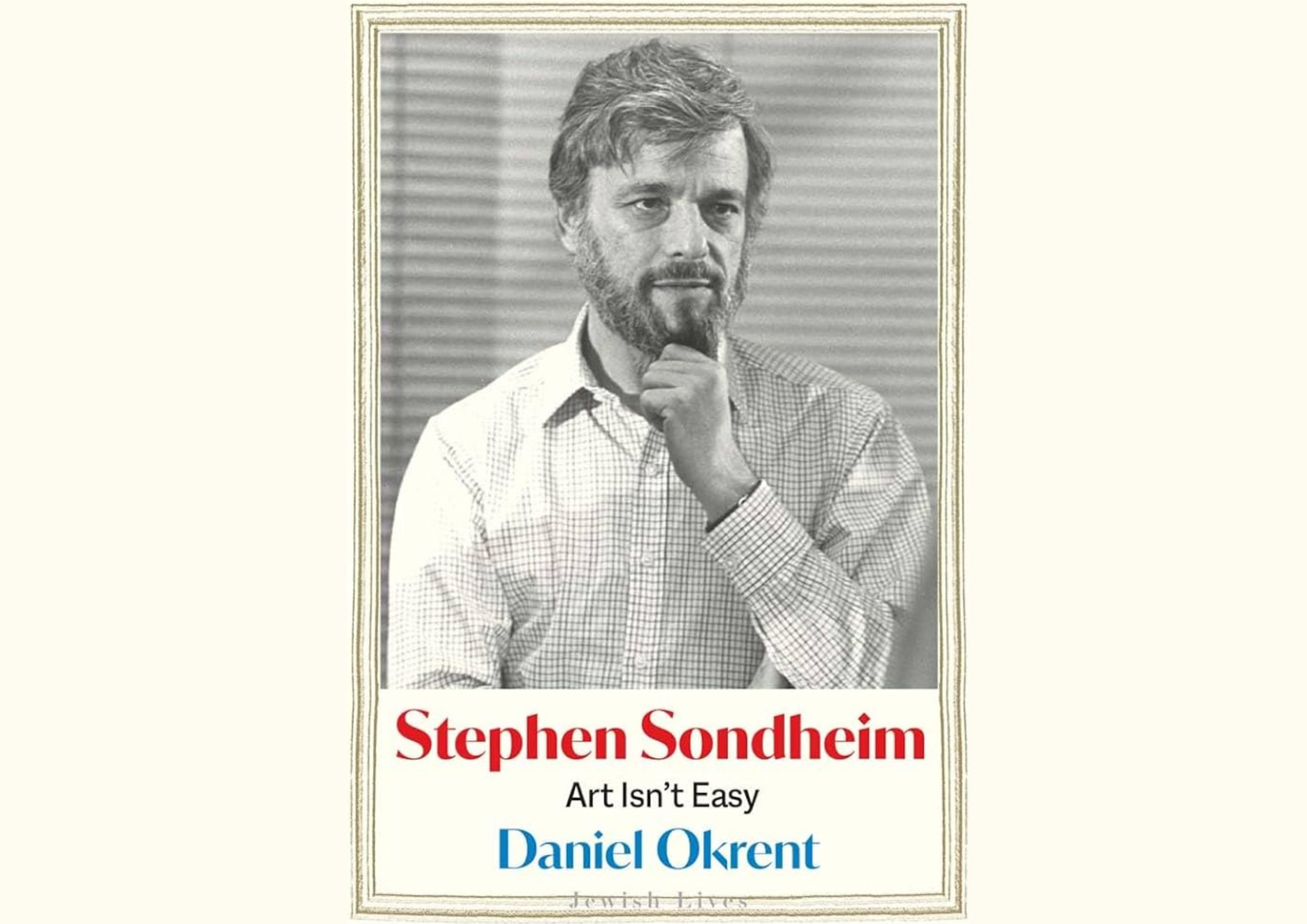





Despite favoring sometimes-ghastly subjects, overly calculated lyrics, and eminently unhummable music, composer-lyricist Stephen Sondheim was something of a conservative when it came to acknowledging his forebears. In Sondheim's case, that chiefly meant lyricist Oscar Hammerstein II, who gladly accepted the role of substitute father to the boy then known as Stevie—a comprehensively unhappy child of divorce—and even more eagerly agreed to school him in musical-making. That he wanted to make musicals in the first place is a testament to the outsized influence of Hammerstein, who, with composer Richard Rodgers, created such masterpieces as Oklahoma! and South Pacific.
"In numberless interviews," writes author Daniel Okrent in his perceptive, efficient new account of Sondheim's life, "Sondheim would later claim that if Oscar had been a geologist, he would have himself become a geologist."
Not fully explained in the book, but certainly obvious to sensitive and non-Sondheim-obsessive readers, is why Sondheim took up Hammerstein's vocation, soaked in Hammerstein's approbation, and treasured Hammerstein's counsel but so thoroughly rejected Hammerstein's worldview.
After all, Hammerstein was a purveyor of a tenderly affirmative vision of life—one that, for Sondheim, featured "the kind of nature imagery that makes me cringe." No one could accuse Sondheim of trafficking in cringe, at least not of the sweetly sentimental sort. One of his most enduring shows incorporates cannibalism into the plot (Sweeney Todd: The Demon Barber of Fleet Street), while another considers the backstories of presidential assailants or aspirant assailants (Assassins). Is it any wonder that he is said to have produced just a single song ("Send In the Clowns" from A Little Night Music) that accrued popularity outside of its show?
Although Okrent presents himself as an admirer of his subject—conceivably a prerequisite for writing a book such as this—he nonetheless gives more than a few clues about what led to Sondheim's commitment to musical-theater shock and awe, despite his early association with more traditional figures like Hammerstein and Leonard Bernstein. The book is part of Yale University Press's outstanding, ongoing Jewish Lives series.
By his own account, Sondheim's troubles seem to have sprung from his mother, the former Etta Janet Fox. A dress designer, Foxy, as she is known, is taken to task for a zest for life that evidently excluded her only son Stevie, born in New York in 1930, who claimed to have been brought up by "governesses, nannies, and cooks," Okrent writes. This is not exactly Dickensian, but the situation clearly worsened after the disintegration and eventual termination of Foxy's marriage to Stevie's father, Herbert Sondheim. Her emotional instability is well-established, and Okrent certainly gives voice to Sondheim's rage at his mother, whom he called "graspingly materialistic" and "a monster." At the same time, he does not hesitate to offer a few words in her favor.
An unnamed family friend judges not Foxy but Stevie the source of much adolescent angst: "Stevie was a whining little shit." More to the point, Okrent credits Foxy, now a divorcée, for pulling up stakes to Bucks County, Pennsylvania, where Stevie was given the unique—indeed, life-altering—opportunity to insinuate himself in the life of one of its residents, Hammerstein. "He might never have met Oscar … without a connection by Foxy," Okrent writes, a sentence that some could argue would be made more accurate by replacing "might" with "would." Life is complicated.
Childish animosity toward parents, especially eccentric single parents, is not unknown among members of the human race, but Sondheim guarded his maternal hatred, justified or not, to an obsessive degree. "His acidulous disdain for his mother and her world was a part of him, packed in a deeply embedded arsenal of disapproval, disgust, and mockery," Okrent writes. On what possible basis could he justify his barb to Richard Rodgers's daughter, Mary, after he received a gift from her of a "large porcelain serving piece": "Thanks for the platter, but where was my mother's head?" He adopted a pose of indifference to her death in 1992, according to Arthur Laurents: "Somebody asked him about his mother and he said, 'Oh, she's the same. Oh, I forgot. She died.'" Again, Okrent is commendably evenhanded. He gently but carefully refutes Sondheim's assertion that his mother, in the 1970s, wrote him a letter in which she stated "the only regret I have in life is giving you birth"—a horrendous remark, if true—by describing Sondheim's response, in which he quotes his mother thusly: "The only guilt I can think of is giving you birth."
Okrent concludes: "There's a mile of difference between regret and guilt, but it was a distance that Sondheim could not navigate."
Sondheim's lifelong nourishment of this hatred may go some way to explaining his early intoxication with horror films ("Late in life, the mention of a B-movie from, say, the early '40s would prompt him instantly to name the director, the stars, and the composer") and his estrangement from all things warm and fuzzy, manifested in his obsession with puzzles, order, and mathematics (the last of which he had intended as his major at Williams College, where he earned a degree in music in 1950). While keeping his feelings about his mother at a boil, Sondheim preferred a state of emotional lockdown when it came to much else. His matter-of-fact, wholly unromantic description of writing songs likely explains why so many have admired their construction but resisted their charms: "I love rules. That's what a lyric is. Set up the rules and see what you can do with it."
Sondheim is said to have reached the conclusion that he was gay as a young man, but there is scant evidence he sought emotional closeness with members of either sex for most of his life. "Snark was his kingdom," said Jamie Bernstein. As early as the 1950s, Sondheim signed up for psychoanalysis because, he said, "I thought, Gee, someday I'll be upset because clearly I'm not attaching myself to anybody and I thought, am I that different from everybody else that I'm not getting into a one-on-one relationship?" At least he knew himself. His attempts at relationships with women ended in awkwardness, including a comic episode in which he and the newly divorced Mary Rodgers shared his residence in an ambiguous arrangement that fell short of actual romance. "So we would get into the same bed, side by side, frozen with fear," Rodgers wrote. "We just lay there. We didn't discuss anything; we didn't do anything. If we touched, it was en passant." Hilariously, Sondheim is befuddled when Rodgers, amid this non-affair, asks him to pick her up at the airport, and he reacted, she said, "as if I'd asked him to eat the leg of a piano." Very late in life, Sondheim entered into a union with a man named Jeff Romley.
The point is not that Sondheim had an unusually tortured life but that he sought to validate, through his work, his prejudices, limitations, and blind spots. Many artists are unhappy with their mothers; few transform that unhappiness into a devastating satirical song, as Sondheim did with "Ladies Who Lunch," a mockery of his mother's milieu, in Company. Some artists never marry or marry late; few are so ignorant of the institution that they feel compelled to conduct an "interview" about the institution with a friend, as Sondheim did with Mary Rodgers when preparing Company—his much-loved meditation on a companionless man not dissimilar from its author. Is it wrong to wonder about the values of a man whose show Assassins ends, as Okrent notes, "with the entire cast pointing guns at the audience"—especially when such a man learned under the tutelage of the artist whose final show, The Sound of Music, ended with the exhortation to "Climb Ev'ry Mountain"?
Because Hammerstein died in 1960, when Sondheim's résumé included writing lyrics for such relatively genteel offerings as West Side Story and Gypsy, we cannot know with certainty how he would have responded to Sondheim's most outré outings. We do know, however, what another early Sondheim collaborator—Leonard Bernstein, who wrote the music for West Side Story—thought of Sweeney Todd. Bernstein told Mary Rodgers that he found the show disgusting to such an extent "to make you want to throw up in your galoshes." Bernstein added: "Steve finally got to write a musical that suits his temperament perfectly." Incidentally, though Sondheim is now regarded as a deity, some contemporary critics expressed views not unlike Bernstein's, including John Lahr, who said Sondheim was "a laureate of disillusion" and "connoisseur of chaos." Unfortunately, Lahr lumped into his analysis Sweeney Todd, which he hadn't yet seen.
Unlike Hammerstein, Bernstein could never have been accused of being a square. Viewers who saw the recent Bernstein biopic Maestro, starring and directed by Bradley Cooper, will know that Bernstein's personal life was, if anything, more congested and confused than Sondheim's. But Bernstein set all that aside to create artworks that were aspirational and salvific: his 1971 "Mass" or his version of Voltaire's Candide. But in what did Sondheim put his trust?
Sondheim would probably answer that he believed in art, especially the diligent effort that goes into its creation. That's the theme of his great song from his show about painter Georges Seurat, Sunday in the Park with George, "Finishing the Hat." "There was the world, and there was the act of creation," Okrent writes. "George chose creation, and so did Sondheim." But this, too, is an all-too-modern sentiment: to valorize creation in and of itself. "Art is as close to a religion as I have," he said, but clearly that wasn't enough as evidenced by his late-in-life inability to make new work. What Sondheim did and did not take from his betters says a good deal about the changes in art over the last 50 or so years.
Stephen Sondheim: Art Isn't Easy
by Daniel Okrent
Yale University Press, 297 pp., $35
Peter Tonguette is the film critic for the Washington Examiner magazine and a contributing editor at the American Conservative.