


Fiction is full of novels that depict the murky intrigue, grubby treachery, and moral compromise of the world’s second-oldest profession. Yet among those serious and credible representations are novels that poke fun at the spying game and its operatives, either with subtlety or with gusto. Graham Greene and John le Carré lampooned the intelligence services in their respective black comedies Our Man in Havana (1958) and The Tailor of Panama (1996). Mick Herron's current series of espionage novels satirizes establishment spooks and politicos and presents the ragtag bunch of failed agents, or "slow horses," at London's Slough House—a place memorably described as "somewhere safe from aspiration"—as Britain’s first line of defense and last bastion of hope.
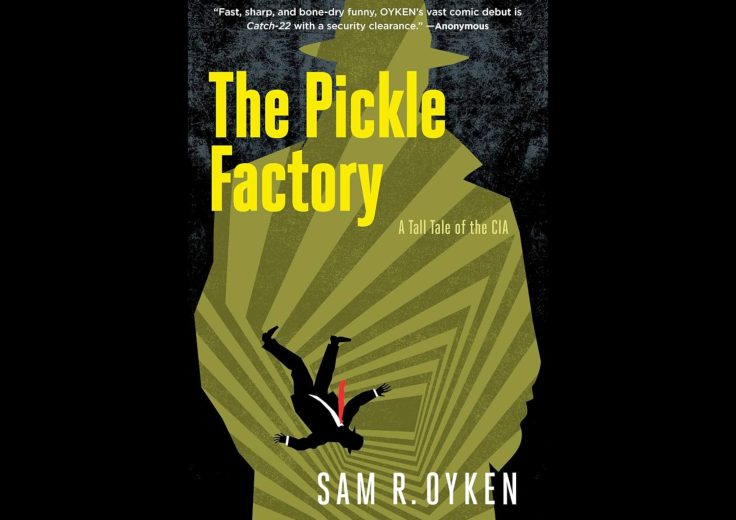
A new spy novel takes ridicule of the secret world to a whole new level. In Sam R. Oyken's riotous debut, The Pickle Factory, the CIA isn't so much mocked as mauled. The author, who uses a pseudonym and evidently worked for the agency in a previous life, has subtitled this spy caper "A Tall Tale of the CIA." Yet despite its fictional front and no end of farcical exploits, it is clear the novel contains many pertinent truths.
Oyken's protagonist, Andre B. KRAY ("not his true name"), is a CIA NOC—a nonofficial cover officer. He has worked for the agency for almost a decade, mostly serving overseas. Used to running foreign agents and spearheading clandestine operations, he finds himself on unfamiliar ground when, for the first time in his career, he is recalled to headquarters. There he meets Division Chief Ignatius Q. HECKFETTER, who informs him that due to a recent cock-up, all employees in the organization are to be referred to by their designated pseudonyms. He also declares that he prefers to go by his real name of Wacker (a curious decision when we learn his name in full). After welcoming KRAY into the fold, Wacker gives him an assignment in the field—one that will test his skill and, in the end, his sanity.
Wacker explains that his department has received a $20 billion windfall. He gives KRAY a month to devise a strategy on how to allocate the sum for Project GOOWIKI: a plan to distribute 1,000 nonofficial cover agents worldwide under the guise of "Transformational Human Resources consultants." KRAY believes Wacker's enterprise is "very very dumb, very very rotten, or both" but signs up for it, vowing to meet his deadline and stay discreet.
Kray (time to cut him down to size and drop his capitals) doesn't remain entirely discreet. First, he confides in his girlfriend and CIA partner in crime, Veronica. Later, at the headquarters' Starbucks ("Nerve center of the CIA"), he encounters Howard W. BUTTONFLY, a contractor, old Cold Warrior, and, in his words, "the Ghost of CIA Past." The pair strike up an alliance, and as Kray shares his doubts about GOOWIKI, his new friend airs his grievances about how the CIA—once known as the Pickle Factory—is a shadow of its former self. It no longer has ambition, daring, and talent. It is now a place run by hapless functionaries fueled by "positions, money, and power." Instead of collecting intelligence it relies on other services to provide it. "We might as well call ourselves 'CLA,' the Central Liaison Agency," grumbles BUTTONFLY.
Kray becomes increasingly disillusioned. His faith in the agency is then profoundly shaken when he receives the bombshell news that seven CIA officers, one of them an ex-Navy SEAL who protected him in Iraq, were blown up in a suicide bombing. Kray discovers the attack was entirely preventable. More than this, he learns that lives were lost as a result of Wacker's negligence. It soon prompts Kray to wonder if the ever-cynical BUTTONFLY might be right in claiming that Wacker is a liar and GOOWIKI a scam, a phony program which moves money around and gets good people killed.
From this point on, suspicion plagues Oyken's hero. To set his mind at rest, Kray jets off around the world to ascertain whether Wacker's GOOWIKI deployments are real. But Wacker has come to distrust Kray and so sends someone to keep tabs on him. Can Kray stay one step ahead and uncover the truth with his dignity, and his life, intact?
The publicity blurb likens The Pickle Factory to both Catch-22 and A Confederacy of Dunces. This is true to a degree but we also get a good dose of Pynchonesque intricacies and absurdities, Kafkaesque bureaucratic irrationality, and Rabelaisian rambunctiousness (the great French writer is even quoted at length). Much of the humor, however, is Oyken's own. It takes various forms. Kray's international mission—one that becomes a "gastrointestinal odyssey" after a mishap in India—comprises a series of hijinks. Wacker, a bumptious, oleaginous cretin, routinely raises smiles. Oyken also sources steady streams of lunacy in silly job titles ("Nondescript Cleaning Lady") and roles (the director of the National Clandestine Service happens to be "dual-hatted" as the CIA's deputy chief of human resources); in agency mafias such as the Mormon Mafia and the Irish Catholic Mafia (which is why the organization is known as "Catholics in Action"); and in the numerous "Funny Names" which include Ebenezer Z. MYPLACEORYOURS, Jesus H. KRYSTE, and the redoubtable Helga Q. FLYSPECK, who has "the eyes of a disgruntled black mamba." A collection of faux news articles about agency blunders and a joke regarding a cut scene from the Tom Hanks movie Cast Away should elicit snorts, snickers, or even out-loud laughter.
There are more madcap antics in the "journal entries" that interlard the main narrative. At regular junctures Oyken purports to shine a light on conspiracies and case histories. We get the lowdown on the counterintelligence chief who went crazy trying to unearth KGB moles, find out about a covert mind program, and learn how the CIA invented WikiLeaks, created Abstract Expressionism, and concocted global warming and obesity to protect national security.
Every now and then, Oyken offsets the ribaldry with some somber interludes. The scenes between Kray and Veronica are touching, particularly when she reveals how the initial excitement she felt at the beginning of her CIA career has been replaced by jadedness after witnessing constant incompetence. Elsewhere a hint of bitterness intrudes when Oyken's narrator states that the CIA's job isn't to go out a decade after the event and kill Osama bin Laden—the CIA's job is to prevent 9/11 in the first place.
When Oyken regales us with pages of palindromes or allows his journal entries to turn into extended flights of fancy, the book gets a little too wacky for its own good. But I suspect Oyken wouldn't have it any other way and refused to temper the exuberance or trim the excess. This is an author who does things on his own terms: Using "CIA" without a definite article, spelling surnames in uppercase, filling paragraphs with lists, blotting text with black-box redactions, and serving up manic detours and wrong turns.
At one stage, we are told the CIA is "a closed, ossified, entrenched, superannuated, corrupt, craptastic, putrid, hidebound, and irretrievably broken bureaucratic echo chamber and dumpster fire." Those in the agency should view The Pickle Factory as an urgent wake-up call. Everyone else should see it as a sharp and scabrous romp.
The Pickle Factory: A Tall Tale of the CIA
by Sam R. Oyken
Ark Press, 401 pp., $29.95
Malcolm Forbes is a writer whose work has appeared in the Wall Street Journal, the Economist, and other publications.