



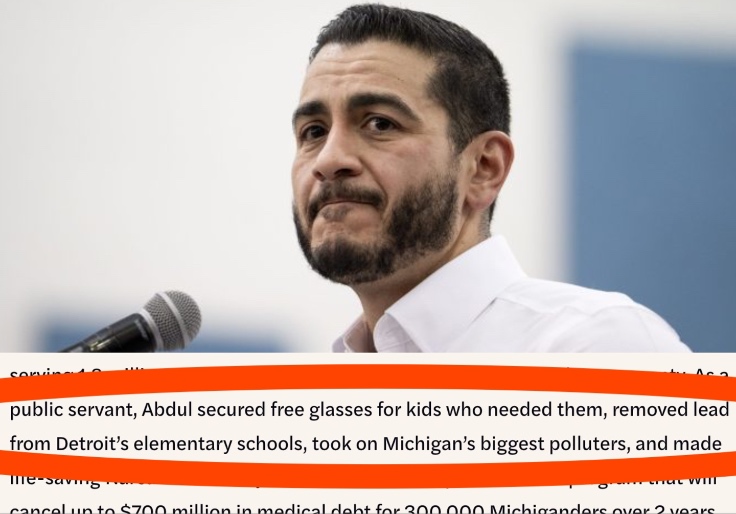
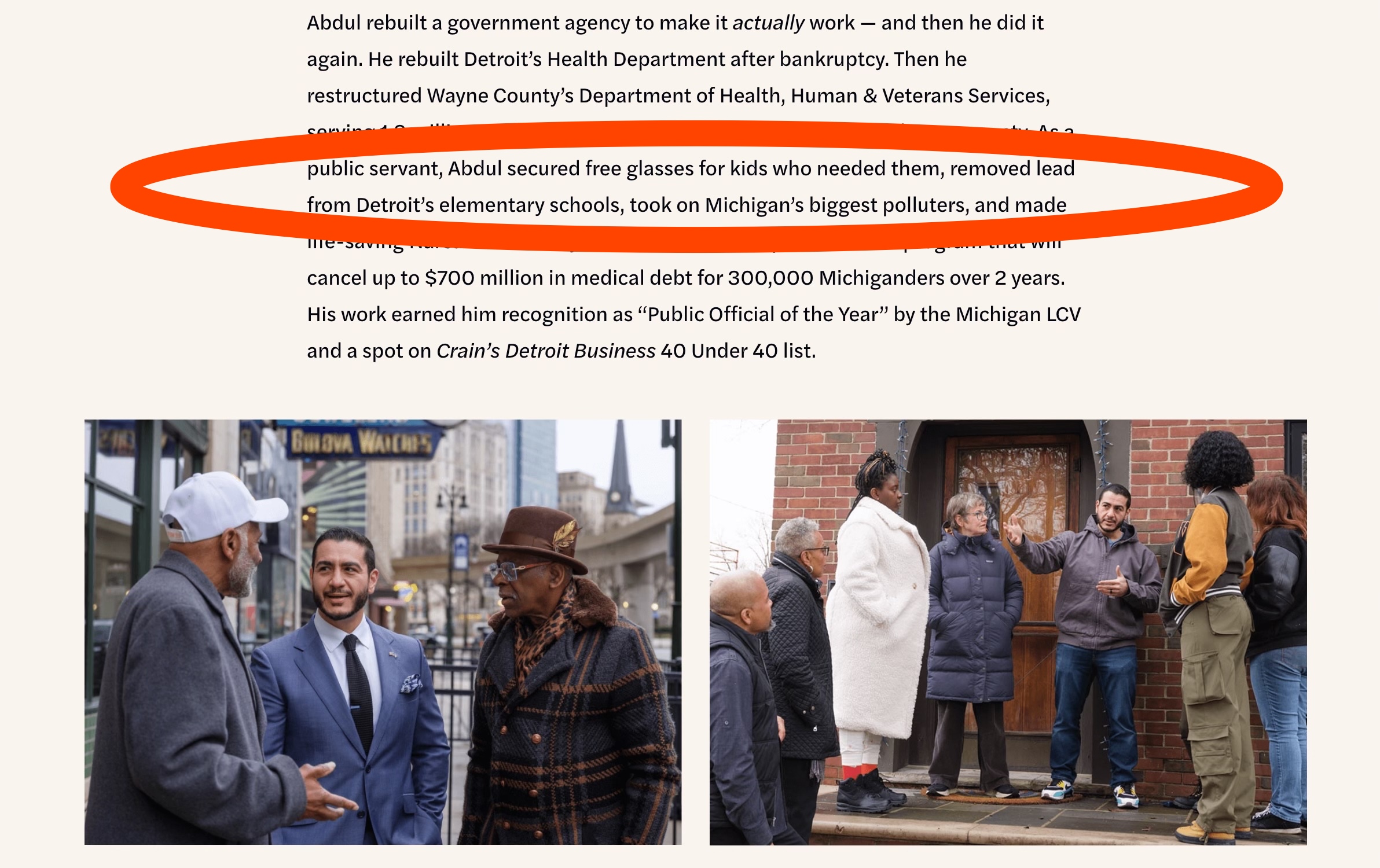
Democratic Senate hopeful Abdul El-Sayed has falsely and repeatedly claimed he removed lead from Detroit's elementary schools during his brief tenure as director of the troubled city's health department. At most, he implemented inadequate testing followed by modest, often failed, mitigation efforts to keep children from ingesting harmful lead and copper, according to legal filings and city records, including documents obtained by the Washington Free Beacon via Freedom of Information Act requests.
When El-Sayed left the Detroit job to run for governor in February 2017, the school district announced that lead levels in school water were under control, and El-Sayed's campaign website states that he "removed lead from Detroit's elementary schools." But according to public documents, tests conducted in March 2017 revealed elevated levels of lead in at least nine schools that had tested positive during El-Sayed's tenure and had undergone mitigation that he oversaw.
The following year, the school system rolled out an extensive testing campaign—a significantly more comprehensive effort than was conducted on El-Sayed's watch—that quickly revealed an elevated metal contamination rate in scores of schools. As a result, in August 2018, the water was turned off in all Detroit public schools.
El-Sayed's provably false claims about lead removal add to a litany of exaggerations, embellishments, and outright falsehoods he has made about his curriculum vitae. These include his false claim to be a physician despite never having become licensed to practice medicine. He's also exaggerated how much medical debt he's had erased more than tenfold and at least doubled how many free eyeglasses he saw delivered to kids as a result of his work as a health administrator in Detroit and surrounding Wayne County—saying the program delivered "tens of thousands of glasses" under him, when 16,000 is apparently more accurate, according to Bridge Michigan.
"El-Sayed has a track record of playing fast and loose with his professional and political history," said Adrian Hemond, CEO of Grassroots Midwest, a Michigan-based bipartisan consultancy. "While not unusual for candidates seeking public office, it is exactly the sort of spin and exaggeration that voters claim to detest."
El-Sayed's claims that he "removed lead" from schools, which he's made on his campaign website since its April 2025 launch, in at least one fundraising pitch and elsewhere, touch a hot-button and racially charged issue in Michigan's downtrodden Rust Belt cities. The roiling scandal over lead-contaminated water in majority-black Flint, Mich., which hit full tilt as El-Sayed took over Detroit's health department in 2015, upended state politics, leading to firings, resignations, and criminal charges.

In the final week before the closely watched primary vote, polling suggests El-Sayed and Rep. Haley Stevens are locked in a tight race for the Democratic nomination for an open Senate seat. El-Sayed has been endorsed by democratic socialists like Bernie Sanders (I., Vt.) and Alexandria Ocasio-Cortez (D., N.Y.). He has sharply criticized Israel and has campaigned alongside the far-left influencer Hasan Piker, who said Israel brought October 7 on itself and that "hamas is a thousand times better" than Israel.
El-Sayed boasts sterling academic credentials, including a Rhodes Scholarship and an M.D. from Columbia. But after finishing his studies in 2014, he hopscotched quickly from job to job, a spotty record he glosses over.
On the same campaign page where he makes the false claim about cleaning up schools' water, El-Sayed says he "has dedicated his entire career to building government agencies that actually work for Michiganders." And yet he spent only a combined four years at such governmental agencies.
In his book, Healing Politics: A Doctor's Journey Into the Heart of Our Political Epidemic, El-Sayed attributes his frequent job changes to frustration in his quest to grandly improve public health. He did not pursue the medical residency required to become a licensed physician. Instead, he became an assistant professor of epidemiology at Columbia but left academia after a little over a year, just after accepting a job at New York City's Mount Sinai medical school that he withdrew from before his start date. Detroit mayor Mike Duggan tapped him, at the age of 30, to return to Michigan and head the city's health department, which had been gutted and privatized amid the city's bankruptcy.
After his 18-month tenure in the Detroit job and his failed 2018 bid for governor, El-Sayed spent some four years working as a political commentator, podcaster, and public speaker and received an array of visiting-academic fellowships. He also founded a pair of progressive political action committees that, according to the Detroit News, ultimately wound down after spending nearly half their cash on consultants and only a small fraction on candidates and ballot initiatives. In December 2022, he joined the Wayne County health department, which handles public health tasks outside Detroit proper. He left the department's helm in April 2025 to launch his Senate bid.
The effort to assess the water in Detroit's public schools came in the wake of the lead-contamination crisis in Flint, about 65 miles north of Detroit, that began in 2014.
Lead exposure can be particularly harmful to young children. The contaminant, which largely comes from old paint and, to a lesser degree, corroded pipes, is tied to developmental delays.
An April 2016 financial and operating plan for Detroit Public Schools stated that "Mayor Duggan suggested the idea" of the voluntary water-testing program for Detroit schools that got underway that spring. El-Sayed's book is vague as to whose idea it was but suggests the testing plan was born out of his team, which he writes he knew could get "angry parents flooding the phone lines" by "promoting the website [where parents could track test results] in the media."
What is clear is that in early 2016, Detroit's health department sent a letter, signed by El-Sayed, offering local schools reimbursement to test their water for lead. The schools conducted testing of only two water fountains and one food-prep sink per school. By April 2016, this testing found elevated lead or copper levels in the water of 19 of 62 schools. Additional testing increased the number of afflicted schools to 24 total by summer's end.
As the district shut off the drinking water in the impacted schools and provided bottled water, El-Sayed's team helped put into place what amounted to stop-gap measures, which he signed off on, including flushing pipes and isolating and removing afflicted water outlets. The school district also contracted with a company that provided a silicate treatment to pipes in 10 impacted schools.
Marc Edwards, a professor at Virginia Tech and an expert in water treatment and corrosion, said that particular mitigation method "is not backed by much proven research, and might not have improved things at all compared to normal Detroit corrosion control. There is some suggestion it can sometimes even make things worse."
Thang Ngu, chief operating officer of DiHydro Services, which the Detroit schools contracted to provide the silicate treatment, said in a phone interview that the treatment is "basically a mitigation process. It doesn't remove the lead." He did not respond to subsequently emailed questions about the implications of the 2017 positive test results in the Detroit schools that had received the DiHydro silicate treatment.
The Detroit public school district publicly declared in February 2017—the month of El-Sayed's departure—that all water levels of the metals were back below EPA thresholds.
But according to the publicly available results of tests conducted in March 2017, 9 of the 10 silicate-treated schools had elevated levels of lead at that time. Multiple academic experts confirmed the significance of these test results to the Free Beacon. Jennifer L. Jennings, a professor at Princeton, said the reports showed that between 6 percent and 100 percent of the water fixtures at these schools had elevated lead levels.
The lead levels were "excessive, by any measure," said Bruce Lanphear, a professor of health sciences at Simon Fraser University. "In short, students and teachers at these schools were being exposed to unacceptably high levels that would increase the risk for decrements and IQ scores, increases in ADHD-like behaviors, and in teachers, the risk of preterm birth."
Jennings said that nationwide, this dynamic among city officials to "declare an all-clear quickly, often by taking individual fixtures out of rotation, is certainly one I've seen before."
Despite the springtime positive test results, a July 2017 Detroit News article reported that "district officials said testing in March showed the water was safe to drink across the district."
Neither the El-Sayed campaign, the Detroit mayor's office, nor the health department responded to a request for comment.
In his recollection of the effort to address the water contamination during his tenure, El-Sayed has tended to focus on lead to the exclusion of copper. He says in Healing Politics that 19 schools "tested positive for lead." In fact, a few of those initial 19 schools tested positive only for copper. Of the 19, he wrote, "In the end, we were able to get every single school to comply with our protocol," referring to the testing and effort to eliminate any identified source. But details from a 2017 decision by a state administrative law judge in an unfair labor practice case brought against the school district suggest that claim was false—given what transpired at the John R. King Academic and Performing Arts Academy, which tested positive for elevated copper and then had its mitigation plan signed by El-Sayed on Aug. 30, 2016.
In early September 2016, the water fountains at John R. King, a large K-8 school, were erroneously turned back on for about a week. One teacher called and told the health department the water was back on. The health department contact told the teacher the water fountains should not have been turned back on, the teacher testified. The judge found that the school district then unlawfully threatened teachers with discipline if they complained to outside agencies or parties about the water.
On the bright side, John R. King was the only one of the 10 silicate-treated schools to have no elevated metals in the water, according to the March 2017 testing.
In his 2020 book, El-Sayed is far more circumspect than he is on his 2026 campaign website, writing that "most of these mitigation efforts were temporary." Without noting that his own tenure ended in early 2017, when he'd left to run for governor, he writes: "In 2018 another round of testing found that many schools had tested positive once again—a reminder that the work always continues."
In the spring of 2018, the school district launched a campaign that eventually included far more thorough tests than El-Sayed had sought, screening all fountains and sinks. These tests identified 57 of 86 schools with elevated lead or copper by the early fall (the figure would rise to 72 by the first half of 2019), including at least 8 of the initial 19 schools flagged under El-Sayed.


The school superintendent cut off the water at all 106 district schools at the outset of the 2018-2019 school year and provided bottled water and water coolers.
Officials blamed aging infrastructure for the metal contamination. The response did include removing faucets. But aside from that, the school district never eliminated all the metal contamination at the source, likely because wholesale replacement of plumbing components would've been extremely expensive.
Instead, thanks to $3 million in philanthropic donations, the district installed a "permanent solution," per the minutes from an Oct. 9, 2018, school board meeting—more than 500 water-fountain and bottle-fill stations in schools that filtered out contaminants, a plan that took until the beginning of the fall 2019 term to reach a critical mass.
"It seems that whatever lead removal or treatment that occurred before 2018 did not fix the underlying problem, since hydration stations were required district wide," said Edwards.
A Free Beacon review of El-Sayed's public remarks, podcasts, and writings could find no instance of him claiming to have removed lead from schools until 2025, when he launched his Senate campaign. Indeed, his prolific podcasting offers further insight into how his account about the water contamination issue has evolved. According to 247 available official transcripts from his public-health-focused podcast America Dissected, spanning September 2019 to November 2025, he mentioned the issue multiple times. But there appears to be no example of him ever claiming to have removed the lead in his podcasts. There are only evident instances of his saying he tested the water.
In an August 2021 episode, for example, El-Sayed said when he was the Detroit health director, he partnered with Michigan's American Federation of Teachers chapter "to make sure that kids had their schools tested for lead in the water."
But in his April 2025 Senate campaign launch, he started claiming he "removed" the lead. A year later, at a campaign rally, he softened this claim, saying he got the schools "on a pathway to being lead-free." Yet to this day, his campaign website continues to claim, prominently, that the El-Sayed "removed lead from Detroit's elementary schools."
On Friday, CSPAN posted a video of El-Sayed responding to a question about the Stevens campaign issuing a press release falsely asserting, "Mike Rogers Endorses Abdul El-Sayed." This followed a CNN report that Rogers had suggested on a private call in June that he was better positioned to beat El-Sayed.
"Lies generally concern me," El-Sayed replied. "A campaign that's confident about its success," he said, "doesn't do things like that."