

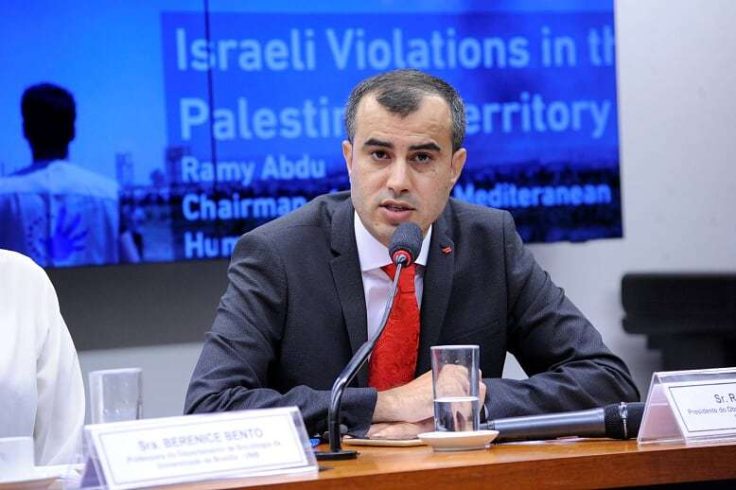
The Hamas-linked founder of Euro-Mediterranean Human Rights Monitor—the advocacy group that was a key source for the May 11 New York Times article that made outlandish claims about Israel training dogs to rape Palestinian journalists—recently declared on social media that Gaza-based journalists have a right to dually serve as terrorist operatives.
Euro-Med Monitor founder Ramy Abdu, who reportedly "has documented ties to senior Hamas leaders," acknowledged in a June 23 Arabic-language Facebook post that "a limited number" of "slain journalists had engaged in acts of resistance prior to their journalistic work—a right belonging to a people living under injustice and occupation, which no fair-minded person can deny." The message was posted just two days before the New York City-based Committee to Protect Journalists announced a wholesale review of its widely cited list of journalists killed in Gaza, which has included dozens of confirmed military operatives for Hamas and other jihadist groups.
Both the CPJ and Euro-Med Monitor served as primary sources in Times columnist Nicholas Kristof’s notorious May report, which at its most salacious, made the bizarre claim that Israeli soldiers raped two Palestinian journalists with a carrot and a dog in two separate incidents of what the Times called "sexual violence." Less than a month since that column ignited an international controversy over the Times’s editorial policies and dueling newsrooms—and a potential lawsuit from the State of Israel—the central sources behind the claims are facing challenges to their own credibility. While the Times’s public relations department has vigorously defended Kristof’s report, and the sources behind it, the outlet has declined to comment—or not responded to requests for comment—as both the CPJ and Euro-Med Monitor are picked apart by various media watchdog groups. Two senior Times employees are on the CPJ’s prestigious board of directors, including the anti-Israel polemicist Lydia Polgreen.
Euro-Med Monitor’s Abdu, in his Facebook posting, said Gazan journalists are being unfairly penalized for also serving in military roles for Hamas and allied terrorist groups like Palestinian Islamic Jihad. Both terror outfits have published a flurry of obituaries in recent weeks acknowledging that many supposed journalists, including at least 20 who once appeared on the CPJ’s list, served on the battlefield. In one recent example, Al Jazeera photojournalist Ahmed Samir Muhammad Washah was revealed to be a Hamas sniper, with videos showing him aggressively firing an automatic weapon in the air and posing with a sniper rifle with an enormous sight while wearing a terrorist group’s headband.
"Within the context of Israel’s war over the narrative and its smear campaigns," Abdu wrote, "footage from their past or obituary statements issued by factions are being exploited to justify targeting the journalistic community. The publication of such obituaries by factions, as well as the circulation of footage showing journalists in military uniforms, serves the false Israeli narrative and undermines the reality that the occupation is targeting journalists and the Palestinian narrative in a systematic and widespread manner."
Many of the supposed Palestinian journalists were—purely based on material released by Palestinians after the men’s deaths—active military leaders, planning attacks inside Israel, and helping to train jihadist operatives.
The Times did not respond to a request for comment on Abdu’s remarks, questions about Euro-Med Monitor’s credibility, or its reliance on the CPJ’s slain journalists list for the Kristof piece and multiple other reports published by the outlet’s two newsrooms (the Times has a dual newsroom structure where its "news" reporters work separately from its "opinion" writers, under different editors with different standards, and it can be difficult for a reader to tell between opinionated news articles and reported opinion pieces).
Euro-Med Monitor also did not respond to a Washington Free Beacon request for comment on Abdu’s post.
Kristof’s lurid Times rape report described Euro-Med Monitor as "a Geneva-based advocacy group often critical of Israel" and cited its claims that Israel engages in "systematic sexual violence" that is "widely practiced as part of an organized state policy." The piece, however, does not note that the organization has a long history of peddling discredited and bizarre conspiracy theories about Israel, or acknowledge longstanding ties between Abdu and the late Hamas leader Ismail Haniyeh, shown with Abdu in this 2011 photo.
"For two years we were told Israel was hunting down innocent journalists. Now Ramy Abdu, founder of Euro-Med—the group that Nicholas Kristof used for evidence of ‘dog rape’—has admitted that some of those innocent journalists started their careers as terrorists," said Jacki Alexander, CEO of HonestReporting, the watchdog group that has exposed multiple Gazan "journalists" as active terror combatants. "At what point do Nicholas Kristof and the New York Times that vouched for him as ‘extensively fact checked’ admit they got it wrong? A correction won't cut it. This calls for a retraction and an apology to every reader they misled."
The CPJ, meanwhile, is facing its own legitimacy crisis. Just days after the organization announced a "full review" of its slain journalists list, CPJ board member and biotech heiress Nika Soon-Shiong announced that she was booted from her post and blamed a Free Beacon report on her anti-Israel activism for prompting the embattled organization to cut ties.
Like Euro-Med Monitor’s Abdu, Soon-Shiong—publisher of Drop Site News and daughter of the South African biotech billionaire and Los Angeles Times owner Patrick Soon-Shiong—said that confirmed terrorists should not be excluded from the CPJ’s list solely for their affiliations with terrorist groups.
"How could CPJ's response place scrutiny on the journalists themselves—as though they were somehow responsible for their own deaths—even after they had been killed? Permanent reputational damage of doing so might undermine the impartiality and credibility on which CPJ's work rests," she wrote in an open letter.
"Reopening the question of ‘who is a journalist’ carries profound implications for the individuals CPJ protects and for the organizations with which they are affiliated," Soon-Shiong added, in comments similar to Abdu’s regarding combatants who claimed to be journalists. "It's a betrayal to our colleagues in Gaza who have faced the deadliest conflict for journalists ever recorded. Because baseless accusations will become more common, not less, CPJ must strive to rise above the fray."