


The mayor of New York City, socialist Zohran Mamdani, who vowed during his campaign to increase property taxes on "whiter neighborhoods," now is promising to put black neighborhoods first in line for one of his signature campaign promises, free childcare.
The directness of his language about using race as a reason for directing government resources could expose the program to a legal challenge. Federal courts have been increasingly emphatic that the equal protection and due process clauses in the Fourteenth Amendment prohibit such race-based decision making. In his opinion in Students for Fair Admissions Inc. v. Harvard, Chief Justice Roberts wrote, "Eliminating racial discrimination means eliminating all of it."
In an appearance on a satellite radio show, "The Reecie Colbert Show," for the Juneteenth holiday, Mamdani appeared to be catering to black constituents. According to a transcript released by the mayor’s office, the discussion went like this:
Colbert: Thank you for being here. Happy Juneteenth.
Mayor Mamdani: Happy Juneteenth. How's yours going?
Colbert: Mine is good. Is yours "Blackity Black?" I can say that. [Inaudible].
Mayor Mamdani: I can confirm it.
Then Mamdani spoke about his free childcare program.
The mayor said, "it's actually not a separate conversation from the one that we're having about Juneteenth, because we know that at the end of four years, we’re going to deliver free childcare to every two-year-old. But we have to build that up and phase it in. So, our first year, we're doing it to 2,000 seats. The next year, 12,000 seats. And in this first year, we had a choice of where do we want to begin. And we made the choice that we wanted to start with the places that are often last, the places that are often facing a choice of [being] last in line or not at all."
He went on, "a lot of these neighborhoods — neighborhoods like Brownsville, East New York, Canarsie, the Rockaways, Fordham [and] Washington Heights — these are neighborhoods that have been disproportionately hit by the cost-of-living crisis and also neighborhoods that Black New Yorkers have helped to build over generations. And it's time that they see a City Hall that is looking to them first, as opposed to even questioning whether it's looking to them at all."
It’s not even really accurate that those neighborhoods are ones "that Black New Yorkers have helped to build over generations." Many of these neighborhoods were "built" by other populations—Italians, Irish, Jews—and unfortunately declined as blacks moved in and the previous residents fled to the suburbs or Florida.
In response to a request from the Washington Free Beacon to clarify or walk back the mayor’s remarks or explain on what basis the policy would be constitutional or legal, a spokesperson for the mayor claimed, "the mayor was clear: a factor in identifying these first four communities was economic need and focusing on areas hit hardest by the cost of living crisis as we scale up." She referred to a statement from March that said, "The initial four communities were selected based on economic need, projected child care demand, existing access gaps, provider capacity and readiness. These first 2,000 seats are designed to serve families in high-need neighborhoods while ensuring programs launch responsibly and sustainably, with inclusive access for children with disabilities and families in temporary housing, including shelters."
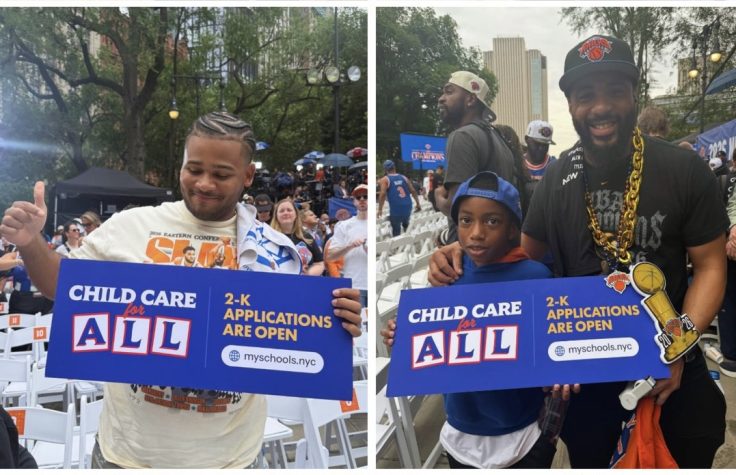
However, hours after the Free Beacon’s inquiry, the mayor posted to social media accounts three Hollywood Squares-style mosaics of nine images each, totalling 27 pictures, with the legend, "Recognize any of these universal child care fans? Just like us, they're excited that for the first time, two-year-olds across New York City are getting FREE 2-K." The people in the images appeared to be from a variety of different racial and ethnic backgrounds. At least ten appeared to be black. The federal census says 21.9 percent of New York City residents are black alone.
Mamdani also touted the childcare program on a radio channel called Black Information Network. "I've been hearing about a new childcare program that you have going on, a collaboration between New York City and the State of New York, and it's something that many African Americans or Black people will potentially benefit from. Tell us about that," the host asked.
The mayor replied, according to a transcript released by his office: "We've seen that for far too long in moments of significant investment, Black New Yorkers are faced with the choice of either being last in line or not at all. And we are seeking to rectify that with this program," Mamdani said. "And so, in this first year where we deliver 2,000 seats, we made the decision that we would deliver those seats in neighborhoods that are often left behind. Like Brownsville, Canarsie [and] East New York in Brooklyn or the Rockaways in Queens or Fordham in the Bronx or Washington Heights in Uptown Manhattan."
He said the "free" seats would "finally relieve that stress of paying at least $20,000 a year for childcare that so many working families are facing in this city."
The mayor could conceivably claim that because he is targeting neighborhoods by race rather than individuals, the program is legal. Or he could claim that because the program is corrective, a remedy to past discrimination, it is legal. However, in recent years, higher-level federal courts have been increasingly skeptical of such arguments. And since some of Mamdani’s recent predecessors, including Eric Adams and David Dinkins, were black, and the state also had a black governor, David Paterson, the city may have a hard time making the claim that black New Yorkers are victims of past discrimination, especially in comparison to other groups, such as Hispanics, Asians, or Orthodox Jews, who could also benefit from the childcare.