




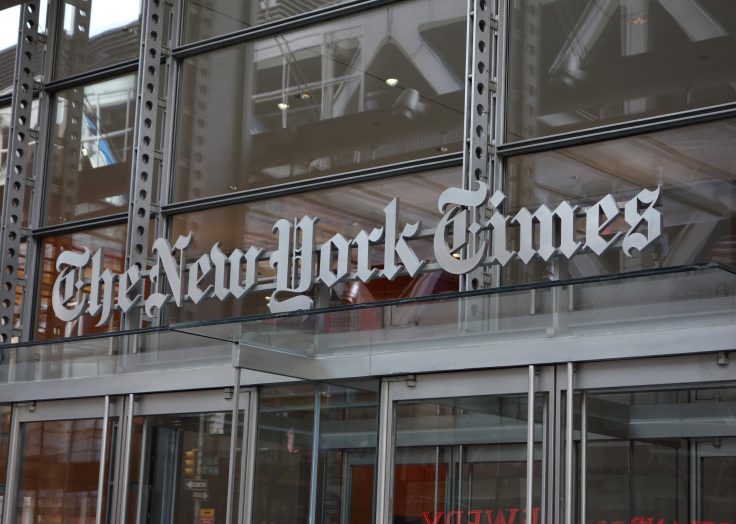
The New York Times, whose executive editor a decade ago publicly acknowledged, "We don't get the role of religion in people's lives," and which has been afflicted with a series of errors on basic matters of Jewish literacy everywhere from the crossword puzzle to the food section, is now hoping to hire a reporter who knows something about Judaism.
A recently posted Times job listing seeks "an experienced and versatile journalist to join the National desk as a religion correspondent ... with a particular emphasis on Jewish life in America."
The posting indicates that the Times is adding a reporter focused on American Judaism and also another one "on the Muslim experience in America," kind of a Times-job-listing version of the higher-education-administrator and Democratic-politician tic of adding "and Islamophobia" every time anti-Semitism is mentioned. As even a Times editorial acknowledged, "University leaders have often felt uncomfortable decrying antisemitism without also decrying Islamophobia." The rise of Islam in America, like the Christian religious revival that is also under way in America, is a newsworthy story in its own right; that Islam-related job listing does not appear to be posted yet, but it could be a promising beat for a reporter skeptical enough to tackle, say, the Minnesota welfare fraud story.
The Times is doubling the size of a religion reporting team that is already double what it was when then-executive editor Dean Baquet lamented, in an NPR interview, "We have a fabulous religion writer, but she's all alone. We don't get religion. We don't get the role of religion in people’s lives. And I think we can do much, much better." As the new job listing puts it, "You'll complement our two current religion reporters, who write expansively about faith and values in America, including topics such as the rise of a new political Christianity, the politics of abortion and technology’s impact on spirituality." The personnel moves at the Times are themselves an indication that even the largely secular mainstream media is waking up, belatedly, to the significance of religion in America.
Whether another two religion reporters in a 2,000-person journalism operation will make any material difference in the truth of the output is an open question. The Times has added lots of reporters covering Trump, another story Baquet admitted missing, but it still has a way of misunderstanding him, as with Peter Baker’s front-page claim that Trump "has endeavored to reverse the globalization and internationalism that have defined U.S. leadership around the globe since World War II, under presidents of both parties." Tell that to the chairman of the Board of Peace.
The Times job listing puts the base pay for the religion correspondent job at between $124,979.94 and $170,000. It lists "Detailed and expert understanding of Judaism and clarity about the intricacies of its place in America" as a basic qualification. "Preferred qualifications" include "Collegial and collaborative behavior, integrity with assignments." How anyone at a news organization approved a job listing that discusses integrity as anything other than a basic requirement is a puzzler, but I guess enough time has passed at the Times since the Jayson Blair scandal that some editor okayed this. "Accuracy" isn’t listed as a qualification, either, though the editors are seeking someone with "an eagerness to experiment with new story forms and a passion for bringing Times journalism to a global audience across digital, print and other media."
Times coverage of Judaism (and, as Baquet acknowledged, of other religions, too) has been almost comically, clumsily bad. The news coverage, while bad in its own right, is also tainted by its association with the Times Opinion pages, whose favorite Jew, Peter Beinart, declared in 2020 that he no longer believes in a Jewish state. (Beinart apologized in November 2025 for what he called a "serious mistake" and "failure of judgment" of speaking at Tel Aviv University in violation of a boycott of Israeli academic institutions.)
The Times executive editor, Joe Kahn, told Semafor’s Ben Smith in a May 2024 interview, "I’m not an active Jew." As I commented then: Maybe the New York Times can sell sweatshirts: "Inactive Jew." Who, exactly, is supposed to find that distinction between "active" and "inactive" Jews reassuring? Maybe they can put it on top of the front page in place of "All the News That’s Fit to Print": "Edited by someone who wants the public to know he’s not an active Jew."
For now, Times coverage of American Judaism is pieced together by a variety of contributors. Liam Stack is a frequently appearing byline on the topic, and his work, like that of some other Times reporters, tends to mislead readers by describing the American or New York Jewish community as divided over Israel or over Zohran Mamdani when the reality is that the mainstream community is overwhelmingly united and the Jews-for-Hamas are a fringe minority, even among the younger generation. Jonathan Mahler, a former managing editor of the Forward, contributes occasional pieces on the topic to the Times magazine. Jodi Rudoren, a former editor of the Forward, returned to the Times in 2025 as its editorial director of newsletters. Joe Berger, who retired officially from the Times in 2014, still pitches in an occasional piece on Yiddish, the Holocaust, or Hasidism.
One of the "two current religion reporters," Ruth Graham, wrote a memorable 2013 piece for SmarterTimes reporting that of the 200 people featured in the Times' "Sunday Routine" column, only 24 of them mentioned that their Sunday routine included church. Graham recently sold a book, Sons of God: Young Men and the Search for Meaning in a New Christian America, to Penguin Random House imprint Viking in what trade publication Publishers Marketplace described as "a major deal, at auction." In Publishers Marketplace terminology, a "major deal" is one involving an advance of a half-million dollars or more. The book is billed as "investigating the seismic shift in the American religious landscape as young men flock to the pews."
Graham has been a gracious critic of Times religion coverage even while working at the paper; in a November interview, she rejected the use of the term "Christian nationalism," which the Times uses sometimes. "We’ve thought really carefully about ‘Christian nationalism.’ It’s a term that was originally used by academics and by activists who were critical of the movement they described that way. And very few people used the term to describe their own beliefs," Graham said, sensibly. "That’s actually changing now, but it’s still essentially people reclaiming what they understand to be a slur. I also think if you asked 10 people what it means, you would get 10 definitions. So for now, I find it more helpful for readers to tell them what a person says and does, rather than to impose a label that would actually be less informative."
Sometimes these job listings are just go-through-the-motions performances for when the paper already has a preferred internal candidate that it is planning to hire. If the Times actually hires someone good from outside the paper it’d be a small miracle, but even so, that person would have to reckon not only with the paper’s editors but also with its audience, heavy with Mamdani and Bernie Sanders voters in America and with even worse in Europe. Maybe after the hire is made, the editors can announce whether they found someone with integrity or if they had to settle for only some but not all of the preferred qualifications. Eventually those intelligent Times readers who remain will have a way of figuring it out.