




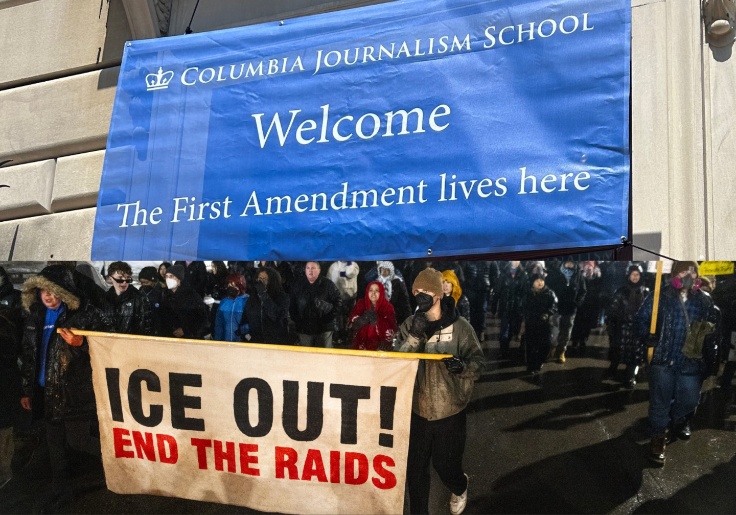
A statement signed "The Faculty of Columbia Journalism School" denounces what it describes as "increasingly aggressive government suppression of political speech throughout the country, including on our own campus, as well as the administration's violent efforts to quell Constitutionally protected protests in Minnesota."
If you thought the job of Columbia journalism faculty was to teach students how to cover those protests and the immigration enforcement operations with an open mind, rather than opining from Morningside Heights in Manhattan on the clashes between immigration enforcement officers and protesters determined to obstruct them, the statement suggests that the faculty members have a different view of it.
That faculty members might have varying views of the Minnesota situation instead of a single uniform analysis is not an option the statement contemplates; rather, it states, "The Columbia Journalism School stands in defense of First Amendment principles of free speech and free press across the political spectrum. The actions we've outlined above jeopardize these principles and therefore the viability of our democracy. All who believe in these freedoms should steadfastly oppose the intimidation, harassment, and detention of individuals on the basis of their speech or their journalism."
I've been following the Minneapolis protests from afar here in Massachusetts, and it seems to me that even if you think an individual immigration officer made a mistake by shooting Renee Good, it's an unproven leap from that to framing the whole situation as the "administration's violent efforts to quell Constitutionally protected protests in Minnesota." Trump got elected in part because Biden wasn't enforcing the immigration laws. Trump has proceeded to try to enforce the immigration laws. Instead of organizing politically for more permissive immigration laws or more lax enforcement, the Minneapolis protesters are running around in cars or with cellphones and whistles chasing or blocking the immigration enforcers. Other protesters have reportedly vandalized vehicles, struck someone in the head with a flagpole, and disrupted a church service.
Think how the left would like it if some Democrat got elected on the basis of stricter enforcement of anti-pollution laws, or of antitrust laws, and when the Democrats sent out the Environmental Protection Agency or Department of Justice officials, they got swarmed by opposition protesters in cars or with whistles and cellphones trying to physically stop them from doing their jobs. Or imagine the Minnesota anti-ICE women were Southern whites trying to block the U.S. Marshals from enforcing civil rights law in the 1960s. You don't even have to agree with that analogy or think that it applies in the Minnesota situation. Maybe it does, maybe it doesn't. But what's the point of a journalism school where the professors not only all have a uniform point of view on the topic but publicly say that if you believe in "freedom" you are required to agree with them: "All who believe in these freedoms should steadfastly oppose…"? Never mind free speech in the streets of Minneapolis, how about free speech and freedom of thought in the journalism school, which is housed in Pulitzer Hall?
These issues are not exclusive to the journalism school, which helps to explain why Columbia appointed a whole committee and issued a whole report on the topic of "institutional voice." The report is no longer downloadable on Columbia's website, but a dispatch in the Columbia Spectator said it advised restraint on issues that "do not directly threaten Columbia's paramount values and fundamental commitments" while also stating that "when the University's paramount values and fundamental commitments are directly threatened, it is incumbent on our leaders to speak."
The language about the Minnesota protests comes in a Jan. 19 post headlined "Columbia Journalism School Statement on Federal Raid of Washington Post Reporter's Home." The facts on that raid are still emerging, but it appears that the primary target was not the Washington Post reporter but rather a government contractor who may have mishandled classified information. The FBI apparently had a search warrant. Law enforcement executed a similar raid against a former Trump national security adviser, John Bolton, and the Columbia faculty was silent. The Columbia faculty was also silent, for that matter, when the Biden administration tried to prosecute Trump for his storage of classified information at Mar-a-Lago. The statement says the raid "appears to be a flagrant violation of the Privacy Protection Act," but that law includes exceptions.
At least two Columbia adjunct faculty members, Walt Bogdanich and Brian Rosenthal, are also on the news staff of the New York Times. A Times spokesman, Charlie Stadtlander, distanced Rosenthal from the letter. "As an adjunct professor who hasn't taught a course since Fall 2024, Mr. Rosenthal was not involved in the drafting or signing of this letter. As a reporter for the Times, he adheres to our standards of ethical journalism, meaning he does not take public stances on political matters or events," Stadtlander said.
Another Columbia faculty member I contacted, Bill Grueskin, who is Professor of Professional Practice and a former academic dean, also distanced himself from the statement. "As a general rule, I don't sign faculty letters. (I think I've done it once or twice... but haven't signed one in... years.)" he said in an email. "Also, I'm on sabbatical (in Utah) this semester so am not really engaged in the J School's day-to-day."
The dean of Columbia, Jelani Cobb, is on the Pulitzer Prize board that has been shoveling awards to anti-Israel writers. He also ousted Sewell Chan as executive editor of the Columbia Journalism Review after Chan mildly and sensibly resisted the notion that the review should become an Al Jazeera–style anti-Israel advocacy publication.
Cobb gave a March 10, 2025, lecture at Oxford complaining, "During the first Trump administration the American press was reluctant to refer to blatant untruths as lies or to refer to outright trafficking in racial stereotypes as racist behaviour. Our own credulity led to the press treating an autocratic president in the same manner as a democratic one." Cobb called for news organizations to boycott Trump in solidarity with the Associated Press: "It is odd that any news organisation, certainly any American one, would continue to attend White House briefings or travel with the President while a reputable outlet has been exiled for a decision made on editorial principle."
Dean Cobb's response to Trump and to the backlash over rampant and vile anti-Semitism has been strident resistance: "capitulation never resulted in salvation. Indeed it seemed only to embolden the most zealous antagonists," he added.
In September 2024, Cobb issued a statement denouncing Israel for closing an office in Ramallah of Al Jazeera, a network that is controlled by the government of Qatar and has been used as cover by terrorists. (Earlier coverage of Columbia, Qatar, and Al Jazeera: "Bollinger Plumps for Al Jazeera," March 15, 2011, and "Columbia Honors Al Jazeera," May 4, 2011.) The Israel Defense Forces have identified at least six Al Jazeera "journalists" as Hamas and Islamic Jihad terrorists. Cobb's statement acknowledged neither the Qatari control nor the terrorists using Al Jazeera cover.
Cobb's Oxford call for a unified press opposition to Trump is similar to the language in the Columbia faculty statement about the need for unified opposition to Trump. As I noted then, ("The Columbia-Oxford-Reuters Jelani Cobb Double Standard") "It's ironic that Cobb's plan for press to combat an autocratic president demands, for its own success, an ideologically uniform press perspective about whether the president is autocratic or not …. A heterodox, non-doctrinaire press is one of the checks on an autocracy—as the framers of the First Amendment understood—so if the goal is supporting democracy and fighting autocracy, the Columbia-Cobb plan could be counterproductive." Same goes for faculty opinions.
Cobb, who is also a staff writer at the New Yorker, will deliver the Martin Luther King Jr. lecture at Brown University on February 23. With any luck the Brown students, who sadly have reasons to be newly appreciative of the value of law enforcement, will press him on some of these issues. While the Brown students are at it they might ask Cobb what he thinks of the journalistic ethics of the New Yorker using an anonymous source to describe Bari Weiss as "conniving." Cobb didn't reply by deadline to my email seeking comment, which, sadly, seems consistent with a decanal point of view that the issues are beyond the realm of reporting or discussion. The estimated cost of attendance at the Columbia Journalism School is $124,599 for 9.5 months. Imagine how much they could charge if the school had a more reliable reputation for teaching students more than one side of a story.



