


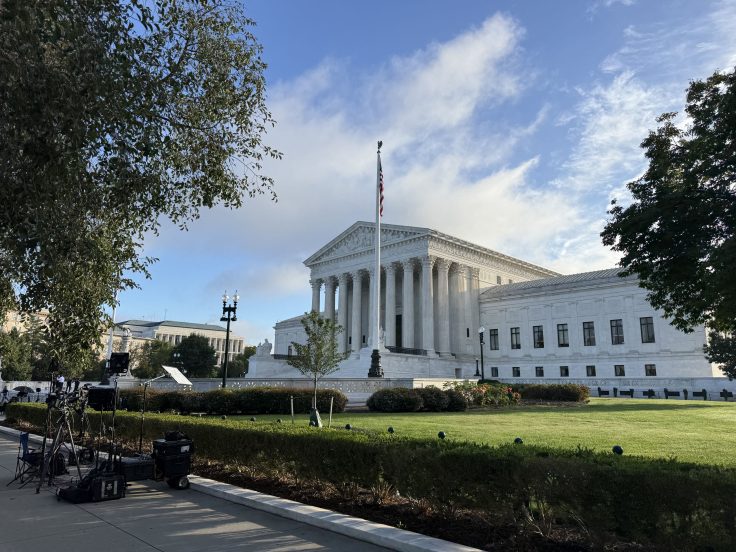
WASHINGTON, D.C.—The Supreme Court heard arguments Monday morning in a high-stakes case that asks if state and local governments can sue energy companies over hotly contested climate issues. At stake is whether a volley of lawsuits against oil companies from Democrat-run cities, counties, and states can move forward.
The case at hand involves officials from the County of Boulder, Colo., who accuse multinational oil companies of deceiving the public about the climate-related harms of the fossil fuel products. Boulder County wants to hold those companies financially accountable for the alleged extreme weather impacts associated with burning fossil fuels. If successful, the lawsuit and other related cases filed by states, cities, and counties across the country could force oil companies to pay billion-dollar fines to cover damages stemming from floods, droughts, heat waves, and other weather events.
The lively arguments, which represented the first oral arguments of the 2026 Supreme Court term, lasted for about two hours in the High Court's iconic marble-adorned courtroom and featured lawyers representing defendants Suncor Energy and ExxonMobil, the Trump Department of Justice, and Boulder County. For the most part, the arguments focused first on whether the issue could be litigated in state court and second, on whether Congress, in setting federal environmental laws for years, has effectively preempted local jurisdictions from pursuing such litigation in the first place.
Kannon Shanmugam, who represented Suncor and ExxonMobil during the hearing, argued the case presents a significant threat because there are theoretically no limits on Boulder's claims—in other words, if successful, the lawsuit could lay the groundwork for tens of thousands of additional cases against both the industry and fuel retailers, automakers, and companies or individuals who emit so-called greenhouse gases. A person who fills their car up with gas could even be liable for those emissions and the alleged downstream weather impacts, he posited.
He also argued the case involves issues that impact energy policy and foreign affairs, matters best suited for the political branches of government rather than the courts. Indeed, Shanmugam pointed to the 1970 Clean Air Act, which sets nationwide emissions standards, and the fact that the EPA is the "first decider" of those standards.
"This case involves an unprecedented effort to use state law to regulate global conduct," Shanmugam said in his opening statement before the Court. "Because of the ambient nature of air and water and the conflicting rights of states, this Court has held for over a century that federal law governs interstate pollution claims. That principle applies with even greater force to claims involving global climate change."
"This suit egregiously exceeds constitutional limits on state authority," remarked U.S. deputy solicitor general Sarah Harris, who represented the Trump administration. "Boulder's theory is that because global climate change causes some Colorado injury, Colorado can hold oil companies liable for all their fossil fuel activities worldwide. That eviscerates the theory … that states can only regulate out-of-state conduct with a direct nexus to in-state injury."
Chief Justice John Roberts, Justice Clarence Thomas, Justice Neil Gorsuch, Justice Brett Kavanaugh, and Justice Amy Coney Barrett appeared sympathetic to those arguments at varying points during the hearing. If those justices do ultimately side with the oil companies and the Trump Department of Justice, it would lead to a narrow 5-3 victory for them (Justice Samuel Alito recused himself from the case last month for an undisclosed reason)—and potentially allow them to remove the case to federal courts and avoid financial liability altogether.
"Counsel, just to make sure I have a correct understanding, presumably, if you prevail, the next day, a municipality in every single state will file a lawsuit, they'll probably copy your pleadings, and then there will be at least 50 different cities—one state could do it, I suppose—causes of action," Roberts said.
"If you prevail, is there a limiting principle to whom you can sue?" Thomas asked, later adding that lawyers "could just as easily sue large retailers" of fuel.
Boulder's lawyer, Kevin Russell, appeared to concede that point, responding that "when lots of people act together to cause widespread harm, it is not uncommon for multiple different defendants to be potentially liable."
Russell further argued the case belongs in Colorado state court because, while emissions from the companies' products may have been generated in other states, Colorado residents and businesses have been negatively impacted.
And he pushed back on the argument that Boulder seeks to use the litigation to set federal policy, flatly stating that the lawsuit is not directly about emissions. He said the case is centered on how oil companies allegedly deceived the public about their product's impact on global warming.
"It is not an effort to reduce emissions," Russell said. "Under our deception theory, they can continue to produce as much fossil fuels as they like and contribute to as much air pollution and greenhouse gas emissions as the market will bear when consumers are properly informed about the consequences of that decision."
"All the tort suit is doing is making them—it doesn't prohibit them from engaging in the conduct," Russell added in response to a line of questioning from Barrett. "It requires them to internalize a portion of the cost of their activities by paying for some of the damage that those activities inflict."
Justice Elena Kagan and Justice Sonia Sotomayor, meanwhile, appeared most skeptical of the oil companies' arguments, repeatedly peppering Shanmugam with questions about jurisdiction. Kagan also noted that states have been successful pursuing similar claims against the tobacco and opioid industries, and said she failed to see the distinction between those cases and Boulder's.
Justice Ketanji Brown Jackson separately pushed back on the companies' arguments, saying that the hearing is taking place too early in the case and the facts are not yet fully known.
Following the arguments, Utah attorney general Derek Brown and Alabama attorney general Steve Marshall, who authored an amicus brief in support of the oil company defendants, said they were confident the Court would rule in favor of the companies.
"Ultimately, it comes down to the real issue of—they call it the sovereignty concept—whether one state can impose their will on another state," Brown told the Washington Free Beacon. "That's effectively what Colorado is doing. They're imposing what is, in effect, an energy tax on other states. My state is right next to Colorado, and it would have an impact on my state, even though we didn't get a vote."
"What the Court's going to decide here is far beyond simply the question that is presented," added Marshall. "It's really: who gets to decide what the energy policy is in this country? Is it going to be plaintiff's lawyers and small jurisdictions? Is it going to be state legislators outside of those that we represent?"
The arguments on Monday, meanwhile, come against the backdrop of the fast-approaching midterm elections where Democrats nationwide have called attention to high gasoline and utility prices. Democratic candidates, though, haven't addressed the Boulder case.
"The same people who are complaining about the price of gas, or just energy generally, have done something that is going to dramatically, if they're successful, increase the price of energy for everyone in America," Brown told the Free Beacon. "Affordability is an issue and this will just make it all the worse."