



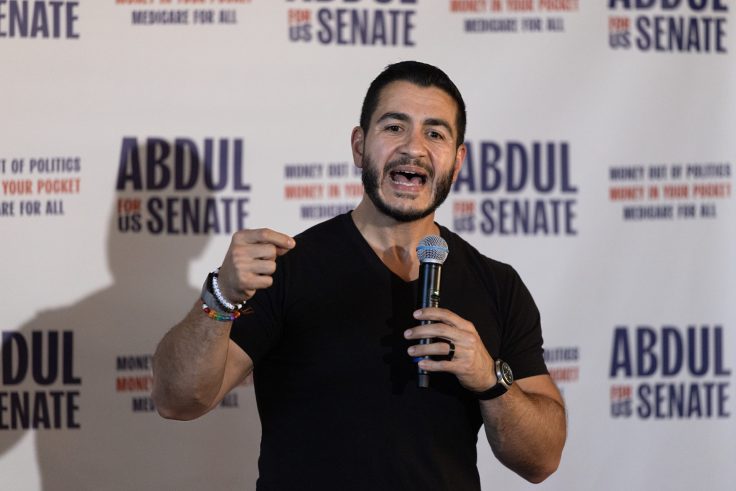
Democratic Michigan Senate candidate Abdul El-Sayed falsely claimed in a 2012 essay that an Iraqi refugee in California was brutally murdered in an anti-Muslim attack because she had the "courage to wear a Hijab." In truth, Shaima Alawadi's husband killed her in an act of domestic violence that he staged to look like a hate crime.
El-Sayed, in an article on March 28, 2012, equated Alawadi's killing with the shooting of Trayvon Martin, a black Florida teenager, as examples of the "racism, xenophobia, and hate" in American society against minorities.
"Trayvon and Shaima were both murdered in cold blood," asserted El-Sayed, because they fit "archetypes indicted by American society as foreign, dangerous, and evil."
Alawadi, a 32-year-old mother of five, died on March 21, 2012, after she was bludgeoned with a tire iron at her home in El Cajon, Calif. Police found a note at the scene of the crime that stated: "Go back to your country, you terrorist."
Though police cautioned early on against jumping to conclusions about the motive—specifically saying they were not at the point of calling the death a hate crime—El-Sayed and other left-wing pundits latched onto the theory that Alawadi was the victim of a hate crime.
According to El-Sayed's article in Mic, a liberal digital publication targeted at younger readers, Alawadi's killer targeted her because she had "the courage to wear a Hijab in a society where Muslims are openly vilified for the crimes of others."
But it's El-Sayed who vilified the wrong party for the crimes of another.
Alawadi's husband, Kassim Alhimidi, was arrested for his wife's murder after police uncovered incriminating text messages and evidence that Alawadi planned to divorce her husband and flee to Texas. Alhimidi, an Iraqi refugee who trained U.S. soldiers to fight in the Middle East, was convicted of murdering his wife in April 2014 and sentenced to 26 years in prison.
There is no record that El-Sayed has ever corrected his false claims about the murder.
The former CNN analyst has a history of making unverified or false claims about anti-Muslim discrimination.
El-Sayed published a CNN essay on Sept. 11, 2012, that claimed the health of Muslims and Arabs was "another victim of 9/11." In the piece, El-Sayed cited a California study that purportedly found a 34 percent spike in premature births for Muslim women after 9/11, which El-Sayed attributed to the "discrimination and marginalization" Muslim women faced after the terrorist attacks. But El-Sayed curiously omitted his own study that found no such increase, the Washington Free Beacon reported. El-Sayed wrote in his study that his "findings contrast with the only other published study that has assessed the relationship between mass trauma and birth outcomes of a specific group." El-Sayed further found that Muslim and Arab women had lower rates of premature births than black or white women.
His shaky claims in the 2012 essay were notable in that the previous year he had completed a doctorate in public health and would go on to work as an epidemiologist.
El-Sayed has continued to use the Islamophobia trope on the campaign trail.
"They want to use my whole name against me," El-Sayed has said, referring to Republicans who intentionally call him Abdulrahman El-Sayed.
El-Sayed has used his full name in many academic studies and media essays, including his missive about the hijab hate crime hoax.
El-Sayed's claims in the essay about the Trayvon Martin case have also failed the test of time.
Martin's shooter, George Zimmerman, was acquitted of second-degree murder in 2013 on self-defense grounds. Zimmerman, who is Hispanic, shot Martin after the teenager attacked him and began punching him and slamming his head on the pavement. The Obama Justice Department in 2015 declined to bring hate crime or civil rights charges against Zimmerman, despite public pressure from the left and an inflammatory remark by the president.
In his essay, El-Sayed pivoted to the larger issue of America's "War on Terror," and lamented the perception that "good-guy American G.I.'s who look like our neighbors and co-workers" were fighting "foreign bearded Arab men."
"And when it captures one of these ruffians, he's openly thrown into a jail cell in Guantanamo with no hope for a fair trial," he wrote.