


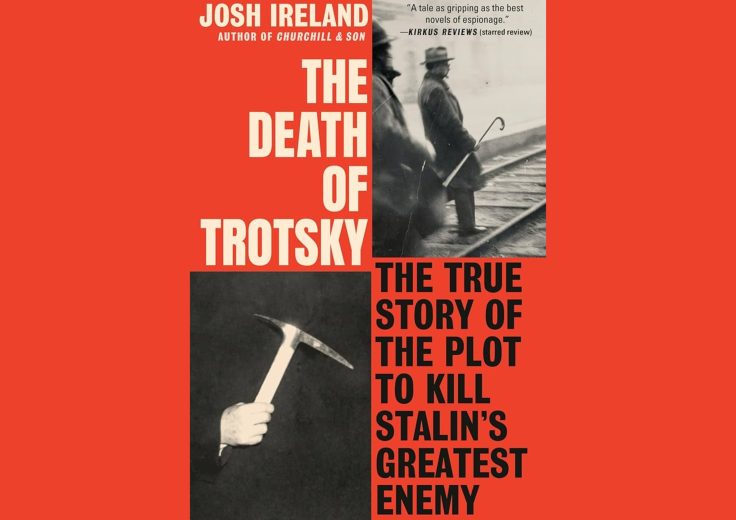
Most readers of Josh Ireland's Death of Trotsky will already know the basic outline of the story: Leon Trotsky falls out with Joseph Stalin after Vladimir Lenin's death in 1924. He proves no match to Stalin; his faction loses critical Politburo debates; he is exiled, eventually lands in Mexico City, where he is assassinated on August 20, 1940, by a Stalin agent, wielding a pickaxe to the skull, no less. His assassin, Ramon Mercader, had wormed his way into Trotsky's inner circle while at the same time serving as an agent of Stalin's secret police. He would be jailed in Mexico while treated like a hero in the Soviet Union.
What Ireland does in his well-sourced and gripping account is to dig deeper into Trotsky's political life, beginning with the Russian Revolution and then civil war, in which he gains fame as Lenin's brutal commissar of war. Trotsky mounted a feeble opposition to Stalin in the early years of Soviet power under Lenin. By 1928 the battle was over. Trotsky was exiled to Alma-Ata. Turkey, Scandinavia, France, and finally Mexico City followed as uneasy hosts to Trotsky and his followers.
Throughout his years in exile, Trotsky well understood that Stalin would not allow a regime opponent of his stature to survive. Stalin based his claim to leadership on his superior knowledge of Marx and Lenin. It was Trotsky who challenged the general secretary on the basic tenets of Marxism-Leninism. In so doing, he was in fact a dead man walking.
Stalin harbored a deep hatred for Trotsky, more than can be explained by his rival's doctrinal disputes with him. From their first meeting in London, the two men knew there was no room for both in the highest echelons of Soviet power.
Trotsky devoted his decades of exile to lectures, polemics, interviews, an autobiography, and a biography of Stalin. These activities put out the word of his alternate communist world, in which the proletariat calls the shots (not Stalin and his politburo) and the goal of world communism remains a priority. It was Trotsky alone who espoused a theoretical alternative to Stalin's real-world communism.
Ireland devotes many more pages to the Trotskyist movement than to Trotsky himself as he works his way through a complex web of true believers contending with petty disagreements and skirmishes. The list is long. Many Trotsky followers went by aliases and false IDs. Being a Trotskyite was no piece of cake. Many were murdered by Stalin's political police, who readily infiltrated Trotsky's cells. There were times when Stalin's agents knew more about Trotsky's inner circle than they knew about themselves. As a reader I would have welcomed more photos of this inner circle. Many are mentioned frequently, and then they disappear into a blur.
This inner circle was comprised of secretaries, translators, and publicists busily distributing his version of Marxism to the outside world and exposing Stalin's doctrinal mistakes. It constituted a virtual publishing house for Trotsky's writings and polemics.
Known as the "Old Man" among his intimates, Trotsky alternated between fatalism and work on his treatises on Marxism-Leninism and his pastime of tending to rabbits and cacti at his Mexico City villa. His daily routine was to receive a stream of visitors wanting to hear what the Old Man had to say about communism. A regular visitor was none other than his eventual assassin, identified as "Ramon," who would be able to time his visits to be alone with Trotsky.
Ireland correctly labels Trotsky as "Stalin's greatest enemy." Whereas other potential rivals sought to ingratiate themselves with Stalin (such as the tragic Bukharin), they failed to understand that no accommodation was possible.
In exile, Trotsky built a cadre of disciples to spread the word to his fellow Marxists. Their ranks swelled as Marxists the world over came to understand the true nature of the Stalinist regime. Some were disillusioned by Stalin's perceived weak support of anti-Franco forces. Their alarm intensified when Stalin arrested and shot, first, unaffiliated "experts" before turning to eradication of the Old Bolsheviks on trumped-up charges. Throughout Stalin's purges, his victims were routinely accused of plotting a "counter revolution" with, of course, Trotsky at its head.
A centerpiece of Ireland's account is the Trotskyites, those Marxists who believed the Old Man offered a superior alternative to Stalin's brutality based upon his ideas of "permanent revolution" and a state run by professional planners, not by Stalin's rubber-stamp Politburo. Thus, around Trotsky there formed a dedicated group who edited his articles and his impending biography of Stalin. They took charge of his material needs and provided him with amateurish protection. Some were Spanish Marxists, recruited during the Spanish Civil War. Others were loyal Trotskyites from Europe and the Americas. The wealthy among them contributed to the Trotsky cause, ready to fund his ragtag operations wherever he landed. Among his Mexico associates were the crème of Mexican avant-garde, Diego Rivera and Frida Kahlo, the latter Trotsky's lover.
Despite his awareness of being under Stalin's death sentence, Trotsky was surprisingly relaxed about security arrangements. Stalin's agents routinely penetrated the inner circle, including Ramon, who had access to Trotsky's villa. In fact, I was puzzled by the fact that Trotsky was not assassinated earlier—Stalin's agents knew his location, and his security arrangements were, as mentioned, pitifully weak.
The most dramatic assassination attempt was organized directly by the Kremlin with Trotsky and his followers in Mexico City. Ireland gives a blow-by-blow account of the NKVD's attack on the villa in the early morning of May 20, 1940. The police assigned by Mexico to protect the exiled leader were asleep. Trotsky and his wife were in their bedroom, and their grandson was down the hallway. After spraying the house with bullets and frustrated by bombs that did not detonate, the assassin team fled not knowing whether they had killed their intended target, who was actually hiding under his bed. Ireland describes the anger in Stalin's office as he and Beria (the new NKVD head) went over the postmortem of the failed attack.
At this point, the mysterious Ramon enters the picture. He and his lover—from Trotsky's inner circle—lived together in a nearby hotel and conducted mysterious business worldwide. Ramon's real last name was not known. He carried suitcases full of pesos on his stealth business trips. Not especially interested in Marxism, he nevertheless volunteered to be the NKVD's assassin. He would wait to be alone with his target for the right moment. His peculiar assassination weapon of choice: a pickaxe, which he could hide under his overcoat.
Ireland gives a gripping account of the day of the fatal attack. Ramon's late afternoon arrival puzzled Trotsky's handlers at the villa entrance. "What's he doing here again?" As the exiled leader leaned over a document, unsuspecting, Ramon struck him on the head with his pickaxe and then fled as Trotsky howled in pain. (Ramon would serve a sentence in a Mexican prison. He would be awarded a USSR distinguished medal when he finally reached Moscow.) Trotsky lived a short time before dying in his wife's arms. One supporter snapped a photo of the dying man, sitting, his head covered by a towel.
Ireland's account supplements an impressive list of biographies by Isaac Deutscher (three volumes), Robert Service, and Bert Patenaude, among others. Trotsky himself wrote an unfinished autobiography (entitled My Attempt at an Autobiography).
Is there room for another biography of Trotsky? As the Soviet archives opened, we have accumulated new insights into the inner workings of the OGPU, NKVD, and other Soviet security organizations. Whereas the classic Trotsky biographies were written by historians, Ireland writes as a journalist/storyteller. As such (and not being a specialist on Russian history), he relies on secondary sources, which he uses admirably. (He has 15 pages of small print notes alongside a massive collection of references.)
Ireland has not written a conventional biography, focusing on Trotsky's upbringing and life as a major Russian revolutionary figure. Rather he is writing a compelling thriller, which focuses on the Stalin-Trotsky battle to the death. In telling the story, he provides a detailed and intricate account of the Trotsky movement, which remains alive even today as the century mark of Trotsky's death approaches. His story of the inner circle is replete with accounts of intrigue, assassinations, reverence for the Old Man, liquidations, and double crosses.
But in telling these tales, Ireland must deal with the perennial problem of writing Russian history—the proliferation of names, multiple names, and Russian nicknames. As a result, the reader's head starts to spin. Ireland perhaps could have provided a register that lists the person's name and pseudonyms. My advice to the reader: Just try and follow the main story line. Go with the flow and enjoy.
The Death of Trotsky: The True Story of the Plot to Kill Stalin’s Greatest Enemy
by Josh Ireland
Dutton, 384 pp., $35
Paul Gregory is a research fellow at Stanford University's Hoover Institution and the author, most recently, of The Oswalds: An Untold Account of Marina and Lee (Diversion Books).