

BOSTON—A federal judge overstepped her authority when she ordered the federal government to pay out hundreds of millions of dollars in research grants to Harvard that the Trump administration had terminated, a government lawyer told a panel of appellate judges Monday.
"There’s no First Amendment right to money," the Justice Department lawyer, Michael Velchik, told the three judges for the U.S. Court of Appeals for the First Circuit. "The district court lacked jurisdiction."
The hearing was the latest legal development in the ongoing clash between the federal government and Harvard, which has widened to issues including antisemitism, racial discrimination in admissions and hiring, and administrative bloat. Harvard has made some limited changes in the general direction of what the government has requested, while simultaneously denouncing the Trump administration for what Harvard asserts is an illegal effort to punish the university for standing up to Trump.
The battle is costing Harvard, whose legal costs ballooned last year to $126,617,412, the highest in the Ivy League. The university also faces budget pressure from an increased endowment tax enacted by Trump and the Republican-controlled Congress, and from enforcement efforts that have scared away some prospective foreign students. Velchik noted, though, that "Harvard is the richest university in the history of the world."
While the First Circuit is considered friendly to Harvard, Monday’s hearing offered a preview of some of the ways the Supreme Court could eventually look at the case. The funding case had been before Judge Allison Burroughs, whose 2019 ruling in favor of Harvard’s admissions process was upheld by the First Circuit and then overruled in 2023 by the Supreme Court. The Supreme Court found the racial preferences in the admissions process, which Burroughs had okayed, were actually unconstitutional discrimination. Trump has called Burroughs a "TOTAL DISASTER," and he mused in July 2025, "How did this Trump-hating Judge get these cases? When she rules against us, we will IMMEDIATELY appeal, and WIN."
Velchik asked the three judge panel—Sandra Lynch, Gustavo Gelpí, and Joshua Dunlap—to reject Harvard’s claims that it was being singled out for punishment. He said the government had treated Columbia University in similar fashion. He also mentioned that some Harvard donors had stopped giving money to Harvard for reasons similar to the government’s, mentioning Ken Griffin, who Harvard’s graduate school of arts and sciences is named for and who recently announced a $3 billion gift to Carnegie Mellon University. He said Harvard’s own task force on antisemitism called for some of the same reforms the Trump administration asked for, casting doubt on the idea that the requested reforms were pretextual or retaliatory.
Velchik said that the case was primarily a contract dispute over government funding and thus belonged in the U.S. Court of Federal Claims.
A lawyer for Harvard, Paul Clement, pressed the argument that the First Amendment was a significant aspect of the case. "The loss of First Amendment freedoms even for a moment is irreparable injury," Clement said. He asked the court to "imagine some future administration" telling Catholic University that it was losing its funding because it was holding too many Masses on campus.
Judge Lynch used the appellate hearing as an opportunity to berate the Trump administration and to praise Harvard. "Harvard took a number of significant remedial steps" in settling two Title VI lawsuits brought during the Biden administration, she said, faulting the Trump investigation for cutting off Harvard’s funding with "no investigation" and "no findings." She didn’t mention that in a separate hearing in the same courthouse on September 24, Harvard and its fancy lawyers had been fighting to deny the government precisely the detailed data the government said it wanted to conduct a meaningful investigation.
Even Judge Lynch, however, seemed to acknowledge from the bench that a positive ruling for Harvard from the First Circuit might not conclude the matter. "There may be further battles down the road," she said.
Clement floated the possibility of returning to Judge Burroughs to seek a contempt of court ruling against the Trump administration if it fails to keep Harvard’s research taxpayer funding flowing from Washington. "I hope it doesn’t come to that," Clement said.
A group that defends boycotts of Israel, the American Association of University Professors, also appeared before the court after Harvard in a case that covered similar terrain. Elizabeth Prelogar, who was solicitor general of the U.S. during the Biden-Harris administration, also claimed the case turned on the First Amendment, insisting it affected "who teaches at Harvard, what classes they teach, and what speech occurs on campus." Prelogar and Clement both argued for the narrowest possible enforcement penalties against Harvard, claiming that any funding reductions should affect not the whole university but only those programs or professors found to be violating antidiscrimination laws.
Velchik said the government is not defending its "freeze orders," just the "termination letters." The government paid out $385 million in National Institutes of Health grants and $50 million in National Science Foundation grants to Harvard after Judge Burroughs’s ruling, he said. "That part of the remedy was unlawful because the district court lacked jurisdiction."
The First Amendment is my personal favorite among the Bill of Rights (with the Fifth and Tenth Amendments close runners-up), but I sat in this same courthouse in October 2018—eight years ago—when another set of highly paid Harvard lawyers were citing the same amendment as justification for racial discrimination in admissions. Don’t take my word for it—you can look it up in Harvard’s eventual brief on the case to the Supreme Court, in which Seth Waxman, William Lee, and Felicia Ellsworth of Wilmer Hale argued, "Diversity—including racial diversity—is indispensable to some universities’ educational missions. As Justice Powell emphasized in Bakke … and Grutter reiterated, universities have long occupied ‘a special niche in our constitutional tradition,’ imbued with a First Amendment freedom to make academic decisions and select student bodies that best realize their goals. … see Sweezy v. New Hampshire ... (1957) (Frankfurter, J., concurring in result) (determining ‘who may be admitted to study’ is an ‘essential freedom[] of a university’)."
On that one, Harvard’s First Amendment claims were resoundingly rejected by the U.S. Supreme Court. The court’s opinion, by Justice Roberts, paraphrased Justice Powell: "a university’s freedom was not unlimited."
And Justice Thomas’s concurrence was also excellent on this point. "Universities’ self-proclaimed righteousness does not afford them license to discriminate on the basis of race. In fact, it is error for a court to defer to the views of an alleged discriminator while assessing claims of racial discrimination. … judicial skepticism is vital. History has repeatedly shown that purportedly benign discrimination may be pernicious, and discriminators may go to great lengths to hide and perpetuate their unlawful conduct. Take, for example, the university respondents here. Harvard’s ‘holistic’ admissions policy began in the 1920s when it was developed to exclude Jews."
If Harvard and the American Association of University Professors genuinely believe that Title VI of the Civil Rights Act of 1964, which states "No person in the United States shall, on the ground of race, color, or national origin, be excluded from participation in, be denied the benefits of, or be subjected to discrimination under any program or activity receiving Federal financial assistance," is in violation of the First Amendment, let them ask the court to strike down the law as unconstitutional. They don’t have the courage to ask for that; instead what they want is weak or nonexistent enforcement when the people being discriminated against are Jews, whites, or Asians. Where were the First Amendment absolutists at Harvard when the amendment was being trampled in the name of campaign finance "reform"? The same Paul Clement, as solicitor general, abased himself by defending the constitutionality of the unconstitutional Bipartisan Campaign Reform Act of 2002 in McConnell v. FEC. The same Harvard people who kicked Rep. Elise Stefanik off a Harvard advisory committee because they didn’t like how she voted now think the Trump administration is the one limiting free speech?
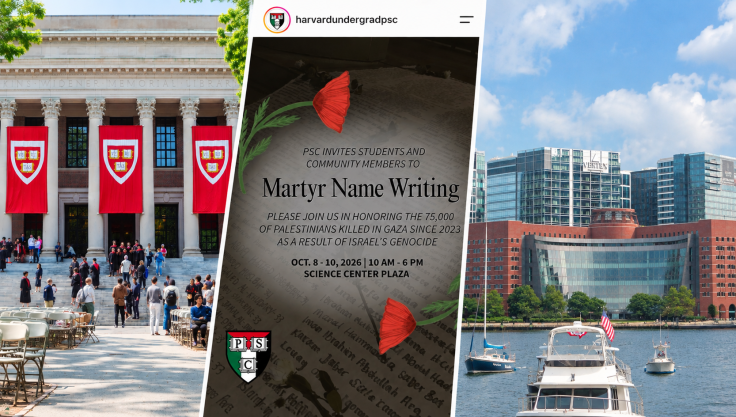
As for the First Amendment concern, the threats to Harvard’s funding have not diminished speech on the Harvard campus that is hostile to Jews or to President Trump. Harvard paid a $35,000 honorarium and $7,500 in travel expenses "for a 5 star hotel" for an anti-Israel speaker to appear on campus on September 24, 2025, the second day of Rosh Hashanah. The New York Times "dog rape" columnist Nicholas Kristof, whose father fought on the Nazi side in World War II, showed up at Harvard last month to humiliate himself and the institution by doubling down on his unsubstantiated fantastical smears of Israel and to denounce Trump as a "charlatan" and a threat to democracy. Harvard won’t disclose how much he was paid. Kristof is married to the vice chair of Harvard Board of Overseers, Sheryl WuDunn. Also last month, Harvard Law School released a new report relying on terror-linked sources to depict Israel as burning Palestinian children to a crisp. Also last month, the Harvard FXB Center released a "Welcome Back" video from its "director of research" highlighting as "extremely important at the moment" its "Project on Palestine Health and Human Rights," which has been a cesspool of anti-Israel bias. The Harvard Undergraduate Palestine Solidarity Committee, apparently with funding from mandatory student activity fees, will be at Harvard’s Science Center Plaza October 8 to 10, 2026, to engage in "martyr name writing," "honoring the 75,000 of Palestinians killed in Gaza since 2023 as a result of Israel’s genocide," it said in a social media post.
Anyway, if the number of high-priced lawyers sitting in the courtroom Monday on Harvard’s payroll is any indication, the university is sparing no expense when it comes to assuring the continued flow of its billions in federal research funding. In addition to Clement, Joshua Levy of Ropes & Gray and Robert Hur of King and Spalding were in attendance. Harvard will be back before the First Circuit on Tuesday Oct. 6 for a case involving student visas. The lawyers stop getting paid as much if Harvard settles with the Trump administration. I’ve heard a lot of cynicism—unwarranted, in my view—about whether Trump’s enforcement actions against Harvard are motivated by genuine concern about antisemitism. Maybe it’s time for at least some symmetrical skepticism about whether Harvard’s legal position is motivated by genuine concern about free speech. Michael Velchik had a much less fancy wristwatch than Paul Clement did and was less smooth of a talker. But "First Amendment right to money" summed up this one pretty well.