


A mounting body of evidence suggests a low-budget film about Islam and Muhammad was not the primary motive behind a series of violent attacks on U.S. embassies abroad, foreign policy experts say.
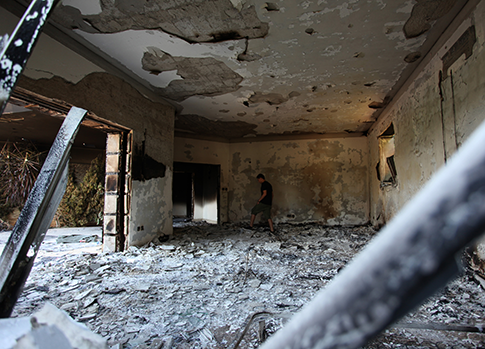
"The attack in [Libya] was not a protest or demonstration but a major terrorist attack—planned and organized in advance by men who had access to mortars and other weapons," Elliott Abrams, former national security adviser for President George W. Bush, told the Free Beacon. "It had nothing to do with any film. It was timed for Sept. 11."
"There’s clear evidence these were planned in advance, especially in Egypt," Malcolm Hoenlein, the executive vice chairman of the Conference of Presidents of Major American Jewish Organizations, told the Free Beacon Friday. "The movie wasn’t up online until Sept. 10, and they didn’t know about it when these things were planned."
News outlets continue to link the so-called "protests" to the anti-Islam film, and have even promulgated false information regarding the video’s purported creator, an Egyptian-American Coptic Christian with a sordid past who originally claimed he was an Israeli-American.
The Associated Press, for instance, reported, "The violence has raised worries that further protests could break out around the Muslim world as anger spreads over the movie."
CNN reported and has promoted a story that the attack at the U.S. Consulate in Benghazi was executed by a pro-al Qaeda group, which used the film as a "diversion."
But the network has also proclaimed that the Egyptian "protests are the latest to roil the Middle East over the online release of a film produced in the United States… that denigrates the Prophet Muhammad."
In a separate report, CNN claimed, "Protesters in both countries were apparently angry about an online film considered offensive to Islam."
Outlets such as CNN and the New York Times continue to label the violent mobs as "protesters" and "demonstrators," though their ultimate desire appears to be bloodshed rather than free expression.
The media also has erred in its depiction of the film’s creator, Nakoula Basseley Nakoula, rushing to incorrectly label him as a Jewish Israeli American, though he is not.
"I find it disturbing and astonishing that the media wouldn’t correct the early reports they made that this was Israeli or Jewish" in origin, said Hoenlein, who called out NPR and other outlets for promulgating false information. "They won’t own it."
Hoenlein chastised major press outlets for jeopardizing the safety of Jewish people worldwide.
"The danger is that we’ve had pogroms for this," he said. "The report that Jews were behind this spread like wild fire."
As American interests abroad continue to face assaults from violent crowds, including in Tunis and elsewhere, Hoenlein fears the misinformation would continue to spread.
"I’m concerned this has a life of its own and in the Muslim world, where not everyone has access to the Internet, they won’t see" factually accurate reports, he said.
The White House, too, has cited the movie as the reason for the attacks, claiming the mobs were not motivated by anti-American zeal.
"This is not a case of protests directed at the United States writ large or at U.S. policy, this is in response to a video that is offensive to Muslims," White House Press Secretary Jay Carney told reporters Friday.
Even as the D.C. press corps and White House focus on a series of perceived "gaffes" by Republican presidential nominee Mitt Romney, foreign policy reporters both here and abroad have disseminated accounts that fail to accurately describe the cause of the violence, experts said.
"It’s important to say clearly that what happened in Libya"—where the ambassador and several other Americans were murdered—"was facilitated and planned by a group that wanted to kill American and likely would have found other pretext" if the offensive film had not existed, Michael O'Hanlon, a foreign policy expert at the Brookings Institution, told the Free Beacon.
"It does not appear to be the main cause," O’Hanlon said.
In Egypt, where angry hordes continue to riot, the Muslim Brotherhood-run government has encouraged the mobs.
"There are certainly other forces at play in Egypt and those forces could easily have contributed, if not have been predominant, in sending those people over the wall," Reuel Marc Gerecht, a senior fellow at the Foundation for Defense of Democracies, told the Free Beacon.
"The film could have fueled it, but the desire to diminish the U.S. in Egypt and decrease the influence of the U.S. is paramount in their minds," Gerecht said.
Matt Welch, the editor in chief of Reason, also attempted to explain how the attacks should not be linked to the shoddily produced anti-Islam film.
"Don’t blame a YouTube movie for ‘inciting’ the mob that killed the U.S. ambassador," read the headline of an article Welch published in Tablet magazine. "Blame the killers."
Egyptian President Mohamed Morsi, a member of the Muslim Brotherhood, even offered a duplicitous statement that both apologized for and condoned the riots.
"Morsi's statement contained no apology to the United States, and there should have been one. He owes us one," said former Bush administration official Abrams. "His government owed it to us to protect our embassy and failed to do so."
Morsi’s tepid reaction to the violence even led President Obama to suggest that Egypt is not an ally—a comment the White House quickly attempted to walk back.
"The president obviously doesn’t know how to handle the Islamic world," said Gerecht, saving additional scorn for Morsi.
"Morsi obviously blew it big time in the way he handled this affair," Gerecht explained. "You’re seeing the real reflexes of a member of the Muslim Brotherhood. The Muslim Brotherhood doesn’t like us and it’s pretty plain [that] it’s unnatural for them to help the U.S."